
Case Study
Operational benefits of preloading with WebGen™
30 Apr 2025
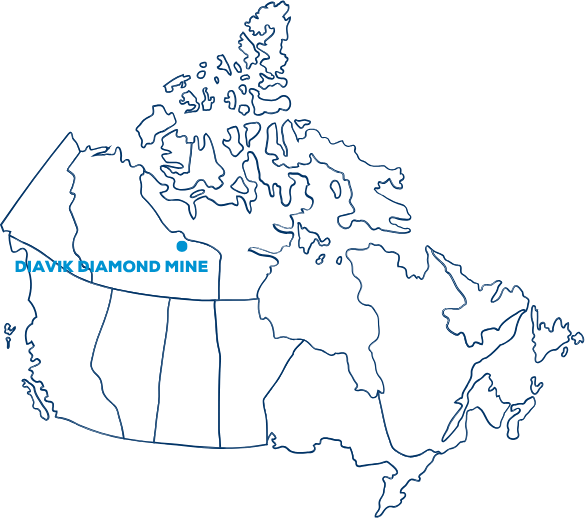
Diavik Diamond Mine, Canada
Located approximately 200 kilometres south of the Arctic Circle in Canada’s Northwest Territories, the Diavik Diamond Mine is owned and operated by Rio Tinto. The site comprises four diamond-bearing pipes, mined using both open-pit and underground methods. Following a successful initial evaluation of WebGen™, this case study explores how Diavik expanded the use of wireless initiation and preloading to enhance operational efficiency across the mine.
The situation
In early 2024, Diavik completed a successful evaluation of WebGen™ technology. This led to a strategic decision to implement full wireless blasting across longhole stoping and sublevel cave operations. By late 2024, Orica and Diavik formalised an agreement to expand WebGen™ usage mine-wide.
To support this rollout, Orica deployed four WebGen™ specialists on rotating shifts and installed three WebGen™ 200 antennas across the site. By the end of the year, approximately 50 WebGen™ applications had been executed across 130 blasts, marking a significant operational shift.
Technical solutions
Slot Development Without T-Drifts
WebGen™ was first applied in Sublevel Retreat (SLR) headings in the A154S and A21 underground mine. Traditionally, establishing an SLR level required constructing T-drifts to connect headings an approach that introduced complexity and risk. With WebGen™, lateral “wing” holes adjacent to the slot were preloaded, eliminating the need for T-drifts. This allowed the initial slot blast to be divided into multiple firing events across the full caving profile. Additional production holes were drilled in a fan pattern behind the slot and preloaded to cast ore toward drawpoints, improving recovery—especially in headings where poor ground conditions limited development.
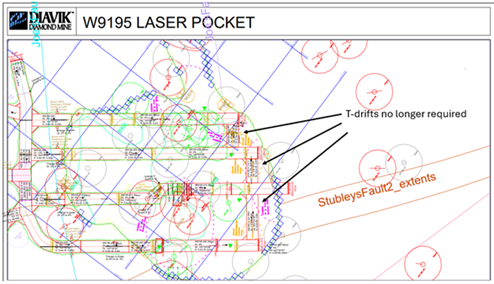
Table | Table | Table | Table | Table | Table |
| Data | Data | Data | Data | Data | Data |
| Data | Data | Data | Data | Data | Data |
| Data | Data | Data | Data | Data | Data |
Lorem ipsum dolor sit amet, consectetur adipiscing elit. Aenean commodo ligula eget dolor. Aenean massa. Cum sociis natoque penatibus et magnis dis parturient montes, nascetur ridiculus mus. Donec quam felis, ultricies nec, pellentesque eu, pretium quis, sem.
Implementation Strategy
- Assessment Phase: Comprehensive evaluation of current systems and processes
- Planning Phase: Development of detailed roadmap and resource allocation
- Execution Phase: Phased rollout with continuous monitoring and adjustment
- Optimisation Phase: Fine-tuning and scaling successful implementations
The result
This gives a summary of the results achieved and the benefits recognized by the customer. This should be expressed in terms of foremost financial benefit then percentage improvement and should include how the blasting benefit translated to value for the customer (e.g. Patterns were expanded by X% leading to costs reducing by Y%, etc.). Always aim for a financial measure (% or cents/BCM). At the very least we need a customer operational improvement benefit. Include a photo/ graph/ image of the resulting benefit. Reflect the actual result/value to what the customer had originally identified. This needs to be in dollar value where possible.
Key Benefits
- Enhanced operational efficiency through automation
- Improved safety standards with real-time monitoring
- Data-driven decision making capabilities
- Reduced environmental impact through optimized processes
- Better resource allocation and management
"Technology is best when it brings people together and creates new opportunities for innovation and growth. Our digital transformation journey is not just about tools, but about empowering our people."
— Industry Leader
Download the full case study
Extra template items
This section is broken into different page components, making them easier to drag around the page. Use or delete as required for your case study.
27% increase in recovery
Using WebGen™ technology LZ5, optimising stope performance and driving efficiency.
27% increase in recovery
Using WebGen™ technology LZ5, optimising stope performance and driving efficiency.
"Technology is best when it brings people together and creates new opportunities for innovation and growth. Our digital transformation journey is not just about tools, but about empowering our people."
— Industry Leader
Table 1 heading
Table | Table | Table | Table | Table | Table |
| Data | Data | Data | Data | Data | Data |
| Data | Data | Data | Data | Data | Data |
| Data | Data | Data | Data | Data | Data |
Video caption goes here
Video caption goes here
Quick summary
Use this table if you'd like a quick snapshot of your case study to be available. Quickly lists the key information in the case study.
Summary | One sentence covering the customer problem statement. |
| Customer Goals | Blast quality and performance, Data insights, Downstream processing efficiency, Ease of use, Field to cloud data workflows, Improve orebody knowledge, Improve safety, Maximise resource recovery, Mine flexibility and scheduling, Operational efficiency and performance, Security of supply, Social license to operate, Sustainability and reduced footprint, Total cost of ownership, Reduce drill and blast costs |
| Industry | Surface Coal, Surface Metal, Iron Ore, Underground Mining, Quarrying, Underground Construction and Tunnelling, Energy, Construction, Civil Infrastructure, Oil and Gas, Agriculture. |
| Products and Services | Technical Services, Total Load Services, Bulkmaster Delivery System, i-kon III, SHOTplus etc. |