

Insight
Can Electronic Blasting Systems be made immune to lightning strike?
07 July 2026
Lightning remains a key safety risk in surface blasting operations. Understanding how different initiating systems respond to lightning is critical for effective risk management.
Key points:
- Conventional wired Electronic Blasting Systems (EBS) cannot be considered immune to lightning strike
- Modern EBS detonators incorporate engineering controls that significantly reduce risk, but these controls cannot eliminate all exposure
- Lightning-induced initiation depends on the nature of the strike, the energy involved, and ground conditions
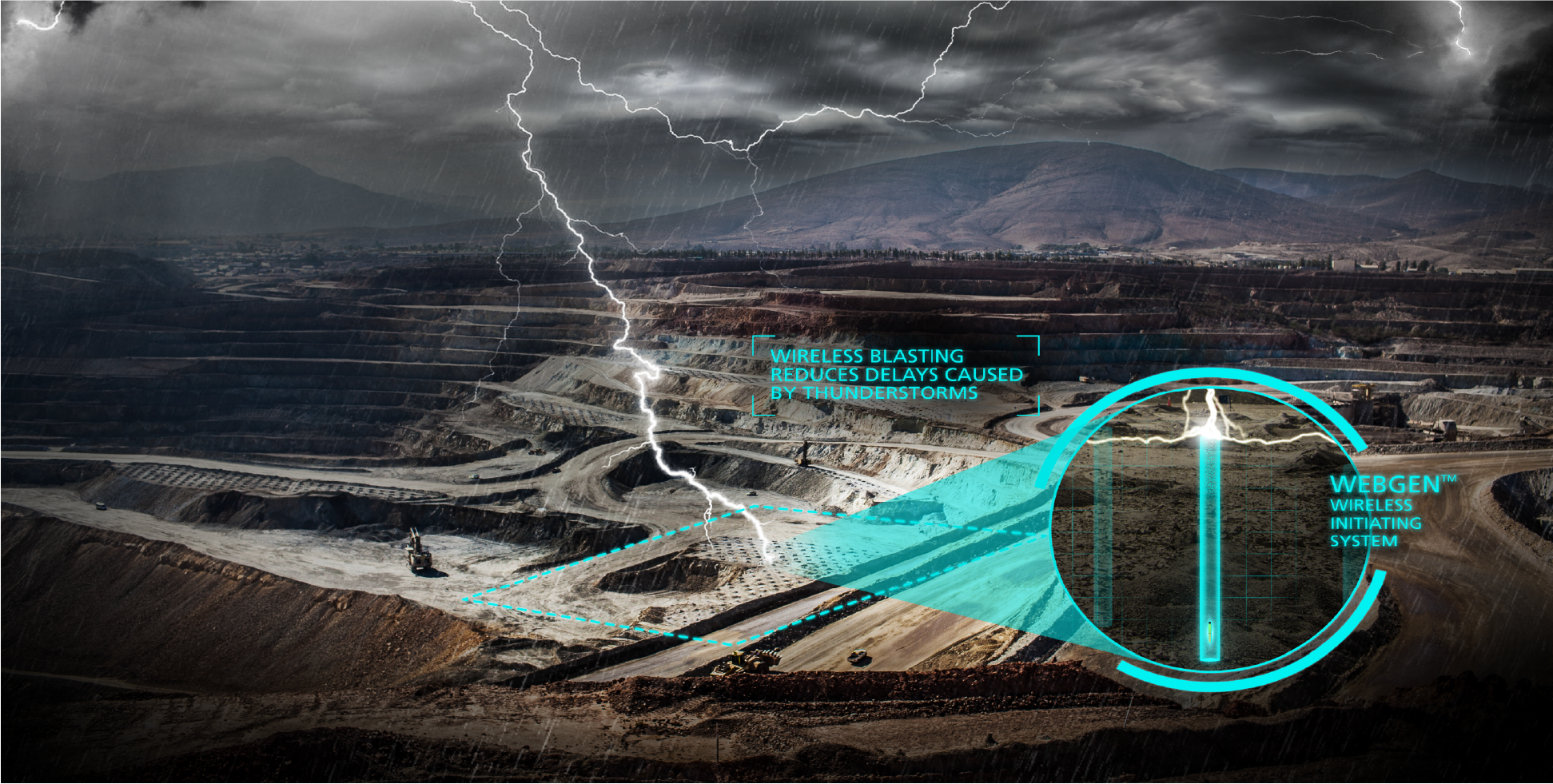
- Use of wireless through the earth blasting technologies such as WebGen™ remove conductive pathways between the surface and the detonator and significantly reduce exposure to lightning-related risks
Download the full PDF
English | Spanish | Portuguese | Russian
Understanding lightning and its impact on blasting systems
Lightning is a brief but intense electrostatic discharge capable of delivering extremely high voltages and currents, with energy release sufficient to significantly impact blasting systems
A cloud-to-ground strike can generate:
- Voltages exceeding 100 million volts
- Currents typically around 30 kA, with extreme events considerably higher
- Rapid energy discharge over a short duration
These characteristics mean that lightning can interact with blast patterns in unpredictable ways, particularly where conductive pathways exist.
How lightning can initiate a blast pattern
Lightning can initiate or influence blast behaviour through several mechanisms:
1. Direct strike: A direct strike introduces high levels of energy into a blast hole. This energy can generate extreme heat and electrical flow capable of initiating detonator components.
2. Stray currents: Nearby strikes can produce electrical currents that travel through conductive pathways into detonators.
3. Induced currents: Lightning generates electromagnetic fields that can induce current flow in detonator lead lines.
These mechanisms highlight the importance of both system design and operational controls in managing lightning risk.
Engineering controls in modern EBS detonators
Modern wired EBS detonators are designed with multiple features to reduce the likelihood of unintended initiation:
- Spark gaps that divert excess electrical energy
- Circuit protections that limit current flow into firing components
- Internal systems that prevent activation without a valid signal
These controls are effective in managing typical induced or stray electrical energy and contribute to the low probability of lightning-induced initiation events in practice
However, these protections have limits under extreme conditions.
Why wired EBS systems cannot be considered immune
The concept of immunity implies that a system can withstand all lightning events without risk of initiation. From a technical perspective, this is not achievable for conventional wired systems.
A direct or near-direct lightning strike can deliver levels of energy that exceed the capacity of engineered protections. In these scenarios, electrical energy can travel through conductive pathways and reach the detonator, potentially resulting in initiation.
For this reason, no wired EBS system can be justifiably described as immune to lightning strike.
What this means for blasting operations
For operations in lightning-prone environments, managing risk requires a layered approach:
• Understanding the mechanisms by which lightning interacts with blast patterns
• Applying robust operational controls such as evacuation procedures and exclusion zones
• Selecting initiating systems that align with site risk conditions
While engineering improvements reduce risk, they do not remove all exposure pathways in wired systems.
Reducing exposure through system design
One approach to reducing lightning-related risk is to eliminate conductive pathways between the surface environment and the detonator.
Wireless through-the-earth technologies like WebGen™ are designed to avoid these pathways by removing the surface connection that can transmit lightning-induced energy into the blast hole.
This design approach reduces the likelihood of energy transfer from lightning into the detonator system and represents an evolution in how lightning risk can be managed in blasting operations.
Supporting informed decision-making
Understanding the limitations and capabilities of different initiating systems allows operations to make informed decisions based on:
• Site-specific lightning exposure
• Operational constraints
• Safety and reliability requirements
Clear, technically accurate information is essential to support these decisions and to ensure consistent understanding across teams.
Frequently Asked Questions
Can wired Electronic Blasting Systems be made immune to lightning strike?
No. Conventional wired EBS systems cannot be considered immune, as extreme lightning events can exceed the limits of engineering protections.
Do modern EBS detonators reduce lightning risk?
Yes. Modern systems include design features that reduce the likelihood of unintended initiation under many conditions, although they cannot eliminate all risk.
What is the most effective way to reduce lightning exposure?
Reducing or removing conductive pathways between the surface and the detonator is one approach to limiting how lightning energy can interact with the system.
Lightning exposure is most effectively reduced by removing the physical connections that allow electrical energy to reach explosives in the blasthole.
In conventional systems, wires and downlines create a direct pathway for lightning-induced currents, increasing the risk of unplanned initiation and forcing operations to stop work during storm events.
Wireless initiation removes this pathway entirely. By eliminating surface wires, there is no conductive connection for lightning energy to travel from the surface to the explosive. As a result, lightning-induced currents cannot transfer to initiation points, and the magnetic fields generated during a strike cannot deliver the encoded signal required to fire a wireless detonator.
This fundamentally changes how mines manage lightning risk—shifting from avoiding exposure through exclusion zones to removing the source of exposure altogether.
Does lightning always result in initiation?
No. Lightning interactions can also lead to detonator damage or system disruption without initiation, depending on the energy involved and system configuration
Lightning risk reduction







The latest EBS Stories

Case Study
Implementing ORBS™ Centralised Blasting System in an underground mine.

News
Inside EBS: Dirk Hummel on the Origins of i-kon™

Case Study
Reducing operational downtime while enhancing quarry blast safety with uni tronic™ 600 remote firing system.

News
Celebrating 25 years of EBS

News
Demystifying Electronic Blasting System (EBS) Dynamic Pressure Resistance Claims.

News
Orica and Oyu Tolgoi partnership drives mining innovation and efficiency in Mongolia
News
Orica at EFEE 2025

News
Transforming mining with WebGen™: the wireless blasting revolution
