
Case Study
Tunnel monitoring, Israel
01 Jan 2020
Monitoring of an existing tunnel next to a new tunnel excavation in Israel
Monitoring Summary
Project: New tunnel digging using blasting techniques and heavy machinery
Contractor: Shikun & Binui Group
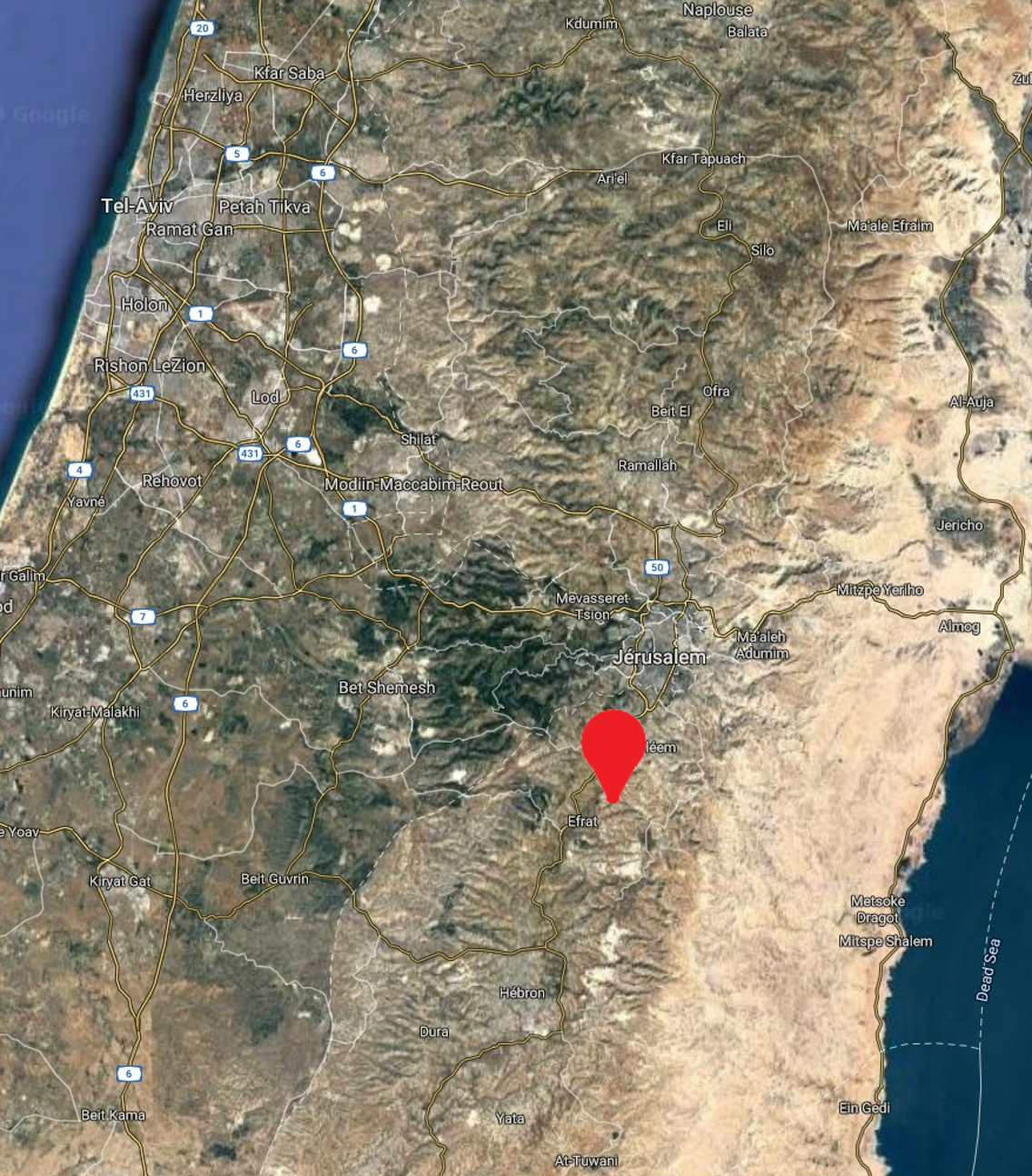
Location: Road 60, between Gush Etzion and Jerusalem
Objective: Automatic vibration data acquisition and transfer to a post-processing software in order to comply with DIN 4150-3 and ensure no impact on existing traffic road during monitoring
Date: From November 2019 lasting several months
Device type: 9 MR3000C with internal triaxial velocity sensor & embedded 4G modem: 4 on the ceiling & 5 on tunnel wall
Data analysis: SCS (Syscom Cloud Software) with email notification and automated PDF reporting (event & background)
Output: Compliance with German norm DIN 4150-3
 |
 |
Abstract
A new tunnel on road 60 between Gush Etzion and Jerusalem is under excavation using blasting techniques and heavy machinery. An existing tunnel next to the new tunnel should remain open to road traffic during blasting and is therefore fully instrumented. Vibration monitoring must be carried out before, during, and after each blast activity, and the monitoring devices must comply with DIN 45669-1. The automatic vibration monitoring data must be shared online and in near real-time, according to DIN 4150-3.
MR3000C devices connected to the SCS (Syscom Cloud Software) are installed to perform the vibration monitoring under the responsibility of the Syscom partner in Israel, Medidot-Advanced Monitoring Technologies Ltd.
Other geotechnical instrumentation is part of the complete tunnel monitoring; it includes total stations, displacement rods, stress cells, and a 3D laser scanner.
 |
Tunnel head monitoring
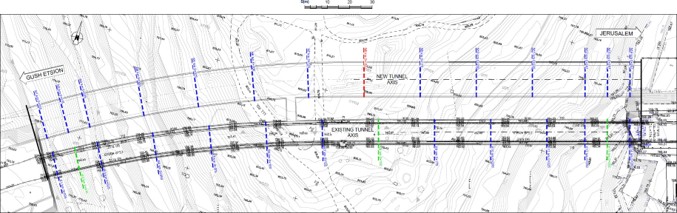
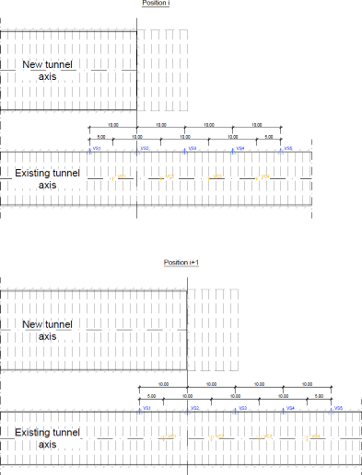
To collect relevant data along the work, the MR3000C devices must be moved several times following the tunnel head, resetting their location with the excavation advance every 10 meters, as defined by the blue tunnel sections in Figure 2.
The geophones are therefore always located next to the headwork, as shown in Figure 3, corresponding to Position i and Position i+1.
VS1 to VS5 labels refer to vertical wall mount MR3000C while VC1 to VC4 labels refer to ceiling mount MR3000C.
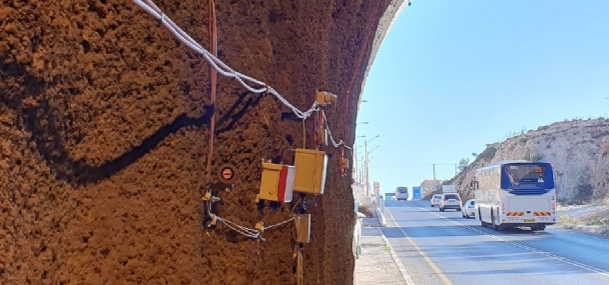
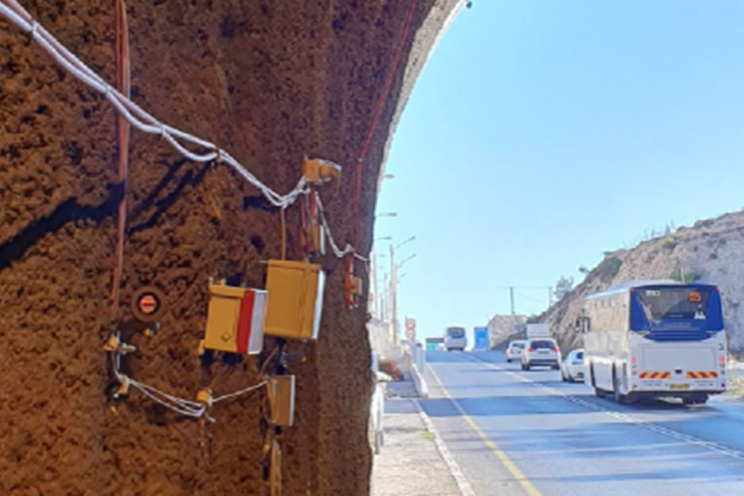
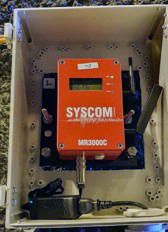
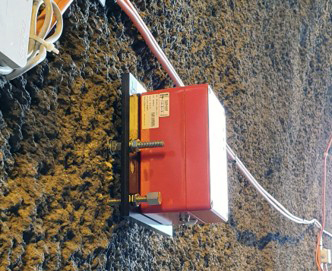
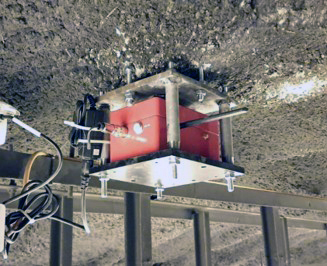
The photos below show the excellent installation and coupling between the rock and the instruments to ensure accurate transmission of blast and machinery-induced vibrations without unwanted interference. This is fundamental to ensure genuine data without altering signal amplitudes or amplifying or attenuating signal frequency spectra.
 |
 |  |  |
Near-real-time notifications with Syscom Cloud Software (SCS)
A specific project objective is to upload and share data online with stakeholders. Thanks to the SCS, this task is fully automated with each MR3000C transferring their recordings directly to the cloud, then processed for an event- or periodic-based reporting and generating email and/or SMS alarms in case of DIN 4150-3 exceedance with very limited warning latency (sub-minute range).
The following screens represent continuous monitoring of data points throughout the project life. In Figure 5, the background plot, as named in the SCS, is well suited for long-term monitoring, making it easy to interpret the average vibration level on site.
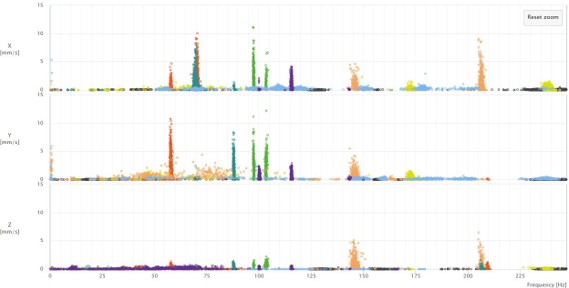
Figure 6 represents a graph with peak velocity amplitudes versus dominant frequencies. As clearly shown, these signals provide genuine information about the tunnel structure's natural frequencies. These results can be further processed and analysed using techniques from experimental modal analysis, SHM (Structural Health Monitoring), or FEM models for computational comparisons.
 |
 |
Conclusion
Automatic data acquisition in near real time with quick and reliable notifications processed using Syscom MR3000C devices and SCS cloud processing solution is a very effective monitoring combo. This solution ensures safe, reliable monitoring of blasting activities with no impact on existing traffic on Road 60. It fully complies with contractor expectations and follows the geophone-based standard DIN 45669-1 (instrument-wise) and DIN 4150-3 (structure-wise).
Special thanks to MSI Tech, who allowed us to write this case study.
- END -