

Case Study
Vibration Monitoring, Grand Paris Express, France
01 Nov 2017
France
Monitoring Summary
Project: Grand Paris, Paris (France)
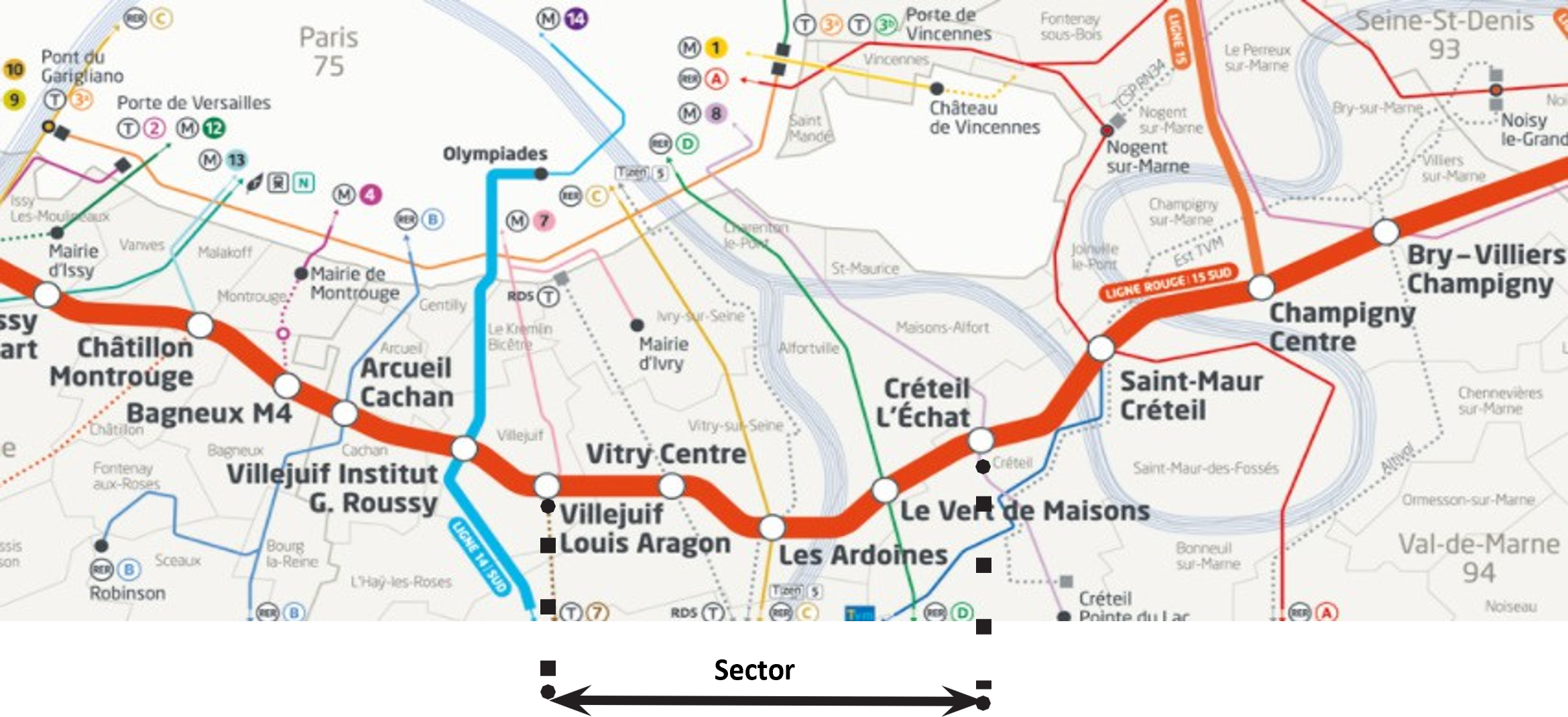
Sector: T2A, on the metro line 15, between stations Villejuif Louis-Aragon and Créteil l‘Échat
Objective: Vibration monitoring of buildings surrounding the construction sites
Duration: Minimum 4 years
Device type: MR3000C with internal triaxial velocity meter
Devices installed: 25 (Nov. 2017) year to date
Output: Data transferred to FTP server and automatic alarm notifications via SMS/e-mails when the trigger level is exceeded.
Grand Paris express project - key facts
City: Paris (France)
Lines: 2 extended lines, 4 new lines
New railway lines: 200 km
New stations: 68
Passengers/day: 2 million
Train frequency: 2 to 3 minutes
Automation: 100% automatic metro system
Urban impact: 90% of lines will be built underground
Duration: Until 2030
Budget: Around 25 billion
 |
Abstract
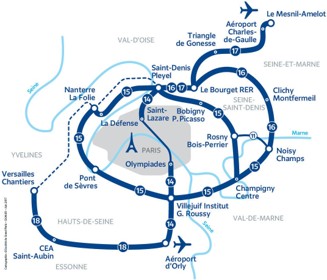
The Grand Paris express is a project for the extension of the transportation inside and around Paris (France). The works are focused on:
- the extension of the current metro lines 11 and 14;
- the construction of 4 new metro lines (15, 16, 17 and 18).
The Grand Paris Express is the biggest urban project in Europe. The company Sixense Soldata is responsible for the overall monitoring of the T2A sector on the new metro line 15, between the stations Villejuif Louis Aragon and Créteil l’échat.
The MR3000C instruments made by Syscom are used for vibration monitoring of buildings surrounding construction sites to reduce environmental impact and disturbances.
25 devices are already installed, and the total expected duration of vibration monitoring is at least 4 years.
 |
Monitoring configuration
The MR3000C used for the structural vibration monitoring have all the following characteristics:
- Internal triaxial velocity meter;
- Embedded 3G modem for internet connection;
- Vertical or horizontal installation, depending on the location;
- External battery pack, in case of main power loss.
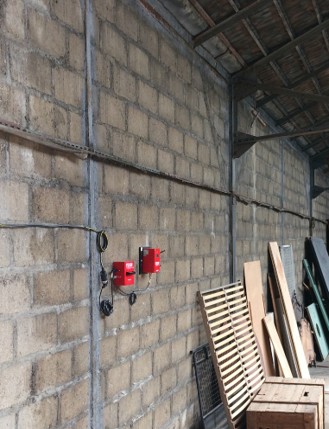
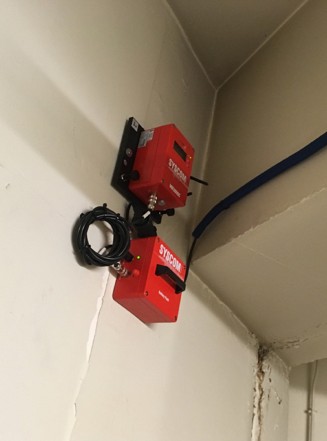
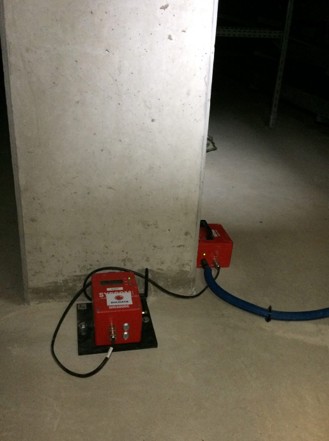
The pictures in Figure 3 show some installations of the instruments: on a warehouse (Figure 3a) and inside buildings, on a load-bearing wall (Figure 3b) or at the foundation (Figure 3c).
In Figure 3a-3b the MR3000C is installed vertically, while in Figure 3c it is installed horizontally. In all cases the devices are fixed by using the holes in their mounting plate.
The MR3000 devices record the following information:
- Event data: the time history of the three components (X, Y, Z) is recorded when the threshold limit of 3 mm/s is exceeded on one of the three axes. The event includes a 1 s pre-event and a 3 s post-event.
Background data: every minute, the velocity peaks of the three axes are saved in a new file. The file duration is 1 hour, resulting in 24 files per day.
 |  |  |
Data transfer and analysis
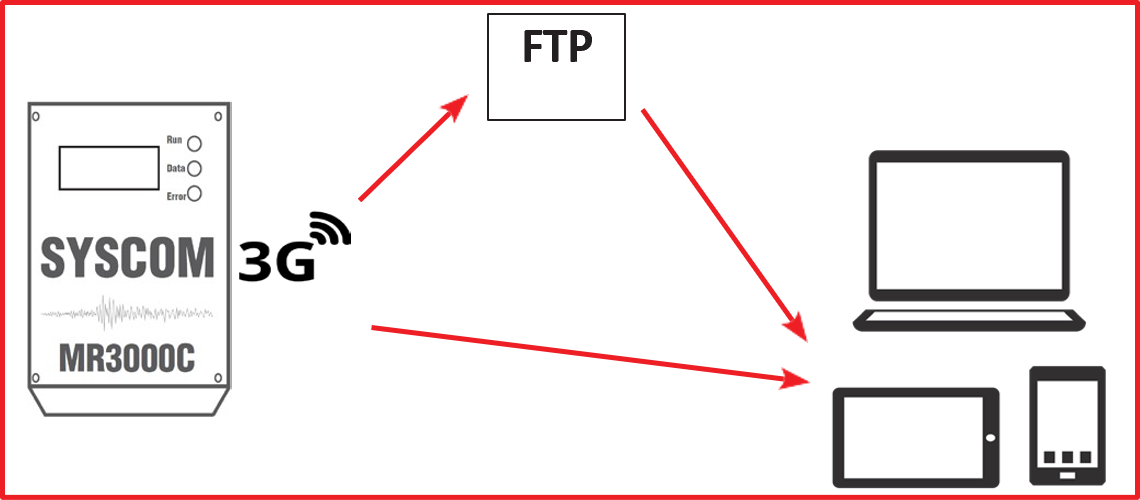
The event and background data are automatically saved in TXT format and sent to Sixense Soldata's secure FTP server. Moreover, e-mails and SMS notifications are sent immediately to the monitoring engineers when a new event is created, informing them of anomalous PPV values and enabling them to reduce work intensity. The communication diagram for the Grand Paris express project is shown in Figure 4.
 |
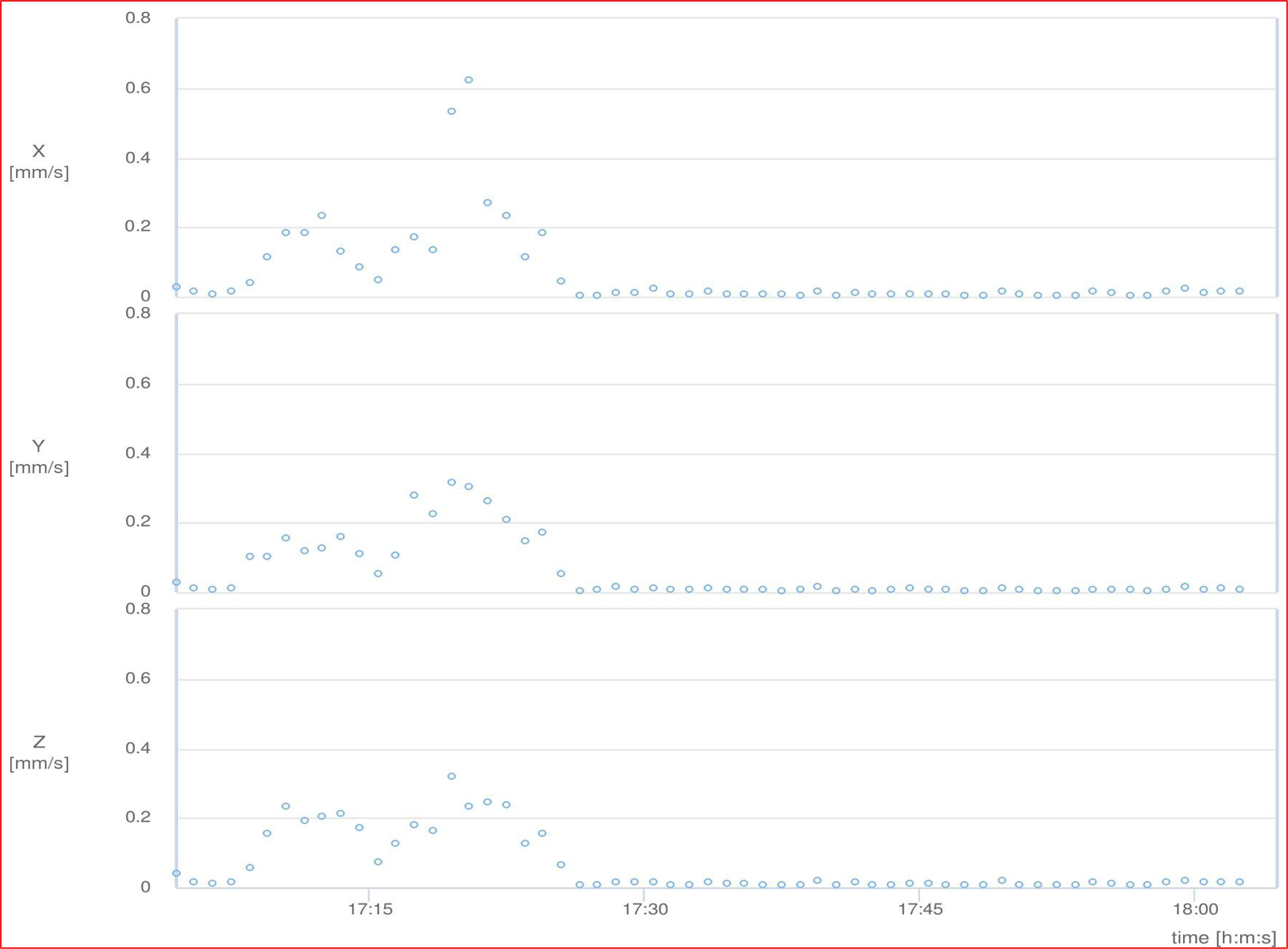
In Figure 5, real background data taken from an MR3000C installed in the T2A sector are displayed. The file duration is 1 hour, indicating that the construction works on site end around 17:30. The trigger threshold of 3 mm/s is not exceeded; therefore, no events are created during this period.
Data in Figure 5 are visualised in the SCS cloud software
The SCS is used for data visualisation and for remote modification of trigger/alarm parameters, as well as for the automatic creation of PDF reports on recorded data, to quickly inform users and authorities about on-site values.
 |
Conclusion
The MR3000C from Bartec Syscom is used for vibration monitoring in the T2A sector of the Grand Paris, Europe's largest urban project. In November 2017, 25 devices were already installed.
The MR3000C instruments are chosen for their high reliability and embedded communication capabilities. Using the internal 3G modem, they automatically send data to the configured FTP server and notifications to monitoring engineers in the event of a velocity level exceedance. Notifications are sent as soon as the event is created to inform users promptly for optimal risk assessment.
The MR3000C units are completely autonomous and independent, resulting in very easy monitoring and management, making the devices suitable for any kind of vibration monitoring project.
Special thanks to Sixense Soldata for supporting us with this case study.
- END -