Case Study
Brine resource assessment with WIREBmr™
01 Aug 2023
Site Profile
The Lake Throssell project covers an area of 1,085km², approximately 180km east of Laverton, Western Australia. The project contains a total drainable mineral resource estimate of 13.3Mt (indicated plus inferred) of sulphate of potash (SOP) with an initial 21-year mine life.
The salt lake acts as a point of discharge for the regional groundwater system; groundwater in the shallow sediments within the lake’s catchment flows towards the lake surface where evaporation is dominant and there is a net loss to the system making the groundwater hypersaline in nature.
The situation
Drainable porosity and hydraulic conductivity are key parameters required for brine deposit resource definition. Drainable porosity coupled with brine chemistry facilitates direct resource estimation, while hydraulic conductivity is the primary driver in assessing brine recovery rate.
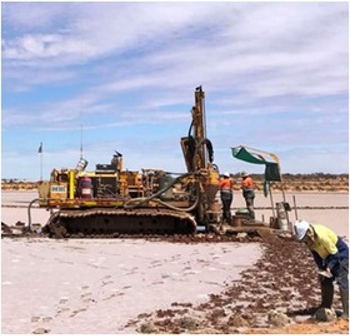
Traditionally, these parameters are measured using costly and time-consuming intervention technologies such as well tests or core samples; the quality of the data derived using these methods is highly dependent on borehole construction which often results in inconsistencies that can lead to possibly spurious conclusions. Moreover, these types of measurements are slow to acquire and are limited to a few sample locations and intervals at different scales.
Measurement of drainable porosity using wireline geophysical tools is an enticing alternative to traditional measures due to its relative low cost, speed of acquisition and its nature as it delivers continuous data downhole. While estimations using resistivity, sonic, density and neutron tools have been used for a long time they all suffer from the requirements of detailed knowledge about formation characteristics to make valuable estimates.
Additionally, density and neutron tools utilise radioactive sources which elevate the health and safety risk of these operations. Given that it is not possible to measure permeability directly, complex multi-parameter, lithology-dependent correlations are used instead that equate permeability with other measured geophysical characteristics. These models are often subject to significant error.
Due to difficult drilling conditions in salt lake hosted brine deposits, wireline geophysical logging must be performed in holes cased in PVC to maintain hole integrity. Few wireline tools can be run effectively through PVC casing.
Technical solutions
WIREBmr™ is a downhole geophysics tool that measures water contained in subsurface environments safely and accurately. WIREBmr™ is specifically tuned to sense fluids within the pore network, enabling precise determination of the formation’s total porosity, mobile fluid content, and bound fluid content. Formation permeability is also calculated without requiring additional wireline data.
As WIREBmr™ delivers a decomposition of the total porosity into fluid volumes of different mobilities, it is possible to effectively estimate drainable porosity as a primary output from the wireline log.
The technology reliably eliminates the need for other wireline methods that require radioactive sources and often cannot be run in PVC casing, while delivering faster and more continuous results than traditional well testing or core measurements.
Due to difficult drilling conditions in salt lake hosted brine deposits, wireline geophysical logging must be performed in holes cased in PVC to maintain hole integrity. Few wireline tools can be run effectively through PVC casing.
The result
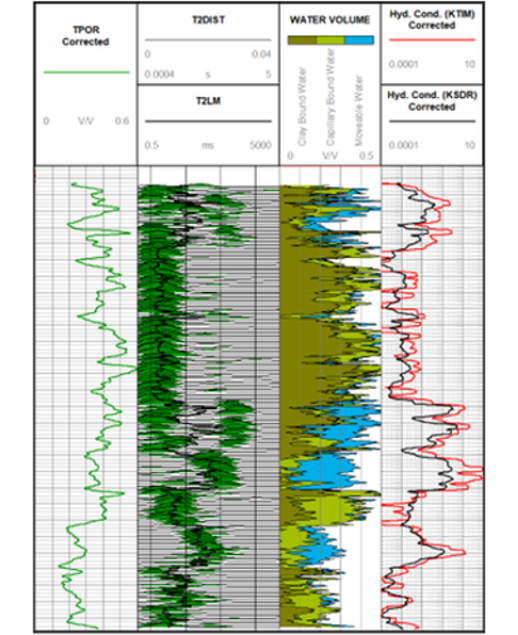
Utilising WIREBmr™ to estimate total drainable fluid coupled with additional brine sampling to evaluate SOP concentration, enabled Trigg Minerals to materially expand the indicated resource at Lake Throssell by 90%, from 4.2Mt to 8Mt of drainable SOP. Figure 1 shows WIREBmr™ results delineating Lake Throssell’s primary target aquifer. In addition, the difference in bound fluid between the upper and lower parts of this aquifer give guidance on future extraction.
Orica Digital Solutions wishes to thank Lake Throssell and Trigg Minerals for their support and permission to publish this case study.
Author: Nick Jervis-Bardy
"WIREBmr logs have provided unrivalled resolution on the formation porosity, permeability, and lithological aspects of the Lake Throssell deposit."
— Keren Paterson, Managing Director, Trigg Minerals
90% expansion of indicated resource
Utilising WIREBmr™ to estimate total drainable fluid coupled with additional brine sampling to evaluate SOP concentration, enabled Trigg Minerals to materially expand the indicated resource at Lake Throssell by 90%, from 4.2Mt to 8Mt of drainable SOP.
WIREBmr™
Learn more about how WIREBmr™ can support your operations.