Case Study
Increasing copper recovery with coarse particle flotation with the Integrated Extraction Simulator
30 Nov 2024
Technology Profile
Eriez is one of the global leaders in innovative flotation technologies, providing complete magnetic separation, metal detection, fluid recycling, feeders and conveyors, material handling equipment, size reduction, and metal recycling solutions.
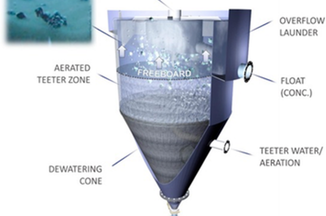
Eriez has developed the HydroFloat™ Coarse Particle Flotation (CPF), which integrates fluidised-bed separation with flotation. With over 80 full-scale HydroFloat™ units already in operation, primarily in the industrial minerals sector, the technology has demonstrated its ability to capture particles that would otherwise be lost. This expands the recoverable range without extensive grinding, improving both recovery rates and overall process economics.
Flotation recovery challenges for both fine and coarse particles are well documented, with the “elephant curve” highlighting the limitations of conventional systems. CPF technologies seek to address these limitations by expanding the recoverable particle size range, reducing energy consumption, and improving over process efficiency.
The situation
A leading copper producer in South America was seeking to evaluate the integration of Eriez’s CPF technology into their processing plant. Lab and pilot-scaled testing had demonstrated promising results, with primary drivers for adopting CPF including reducing valuable material loss in coarse particle sizes, minimising the environmental impact of acid mine drainage (AMD) and wet tailings, and addressing the high energy demands of traditional comminution.
Key information required during CPF projects development is the assessment of the integration into existing circuits and understanding the best configuration for maximising the metallurgical and environmental benefits. To perform these studies, the mining operation partnered with Orica Digital Solutions to utilise the Integrated Extraction Simulator (IES), a platform already developed for the site’s full value chain, to incorporate CPF models and simulate its incorporation in the current concentrator plant.
Technical solutions
Orica Digital Solutions deployed IES, a cloud-based simulation platform designed for modelling complex mining operations from blasting through to final concentrate, to tackle the site’s CPF challenges. IES’s versatility in handling both industry-standard models and custom-development models made it an ideal solution for this scenario, particularly given the unique operational dynamics of the HydroFloat™ technology.
The team used IES’s machine learning module ModelNet™ to build a neural network model of the CPF circuit. By leveraging machine learning, ModelNet™ could capture complex, non-linear relationships within the data that would have been difficult to model using traditional methods. This flexibility was particularly valuable given the relatively limited historical data on CPF performance.
The project was executed in three stages:
- Model compatibility and adjustments: existing phenomenological models were reviewed and modified to align with the IES platform.
- Neural network model development: using data from Eriez’s pilot tests (70 samples), the team trained a neural network in ModelNet™ to predict CPF performance.
- Training and technology transfer: the final stage involved training site personnel to use the models, run simulations and report results.
A key activity was performing mass balance calculations within IES, ensuring accuracy in the simulated CPF model integration.
The result
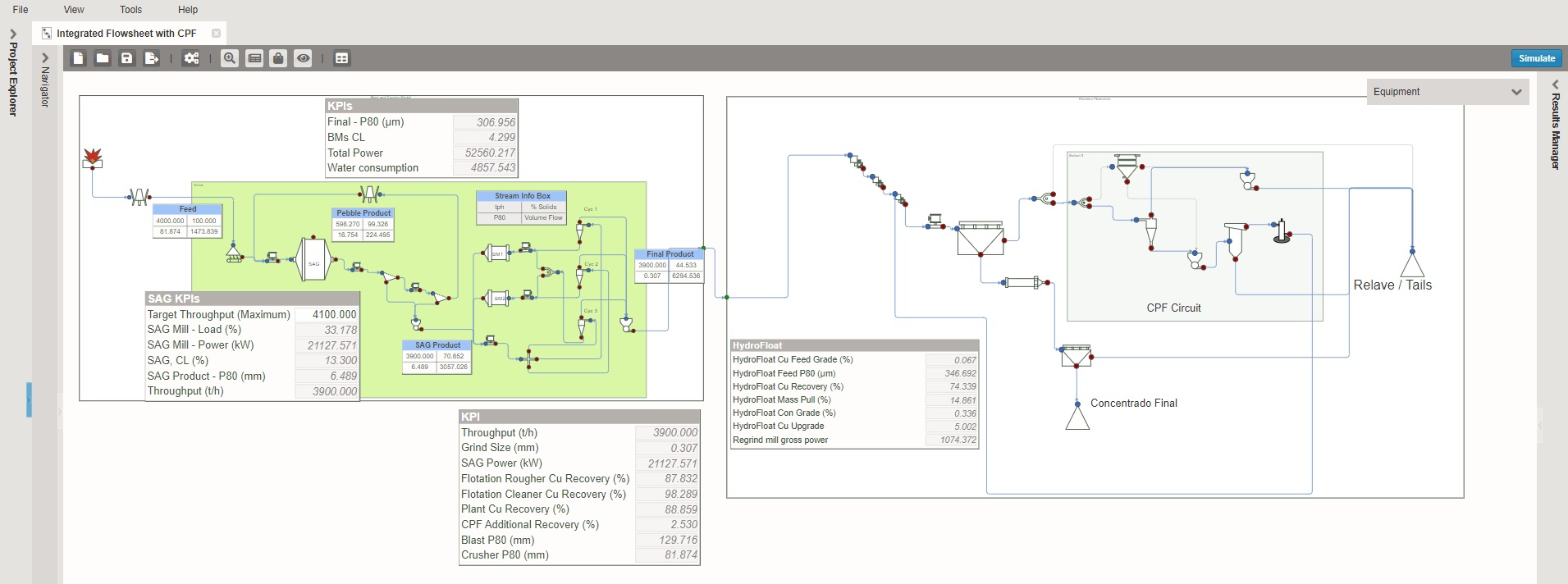
The previously developed value chain flowsheet for the mine site was successfully updated with two new models to account for CPF integration: a size-grade deportment model for the comminution feed stream and a sized-based flotation recovery model. These new models allowed more accurate simulation of particle behaviour, replacing unsized recovery data with size-specific recovery predictions.
Each piece of equipment, including the hydrocyclone, was modelled independently, using single-component separation efficiency models. The HydroFloat™ incorporated metrics like copper recovery and mass pull, with data-driven insights derived from pilot tests.
Scenario analyses were conducted to evaluate the impact of CPF integration. Simulations with CPF circuits on and off, classifier configuration variations, and different deposit units were tested. The results showed an increase in copper recovery ranging between 2% to 7%, demonstrating the potential of CPF integration to boost recovery and enhance process efficiency.
This highlights the successful application of IES in integrating advanced CPF models into an existing flowsheet. By combining operational and test data, the simulation allowed the mine site to optimise the CPF circuit design before full-scale implementation. The HydroFloat™ technology’s ability to significantly increase recovery, particularly for coarse particles, has proven essential in improving overall plant economics and reducing energy consumption.
Orica Digital Solutions wishes to thank Eriez for their support and permission to publish this case study.
Author: Paulo Lopez Pardo
Improved plant economics
By combining operational and test data, the simulation allowed the mine site to optimise the CPF circuit design before full-scale implementation. The HydroFloat™ technology’s ability to significantly increase recovery, particularly for coarse particles, has proven essential in improving overall plant economics and reducing energy consumption.
Up to 7% increase in copper recovery
The results showed an increase in copper recover ranging between 2% to 7%
Integrated Extraction Simulator
Learn more about how the Integrated Extraction Simulator can support your operations.