
Case Study
Structural Health Monitoring (SHM) and Experimental Modal Analysis (EMA) of a Dam Radial Gate
08 May 2025
France
Summary details
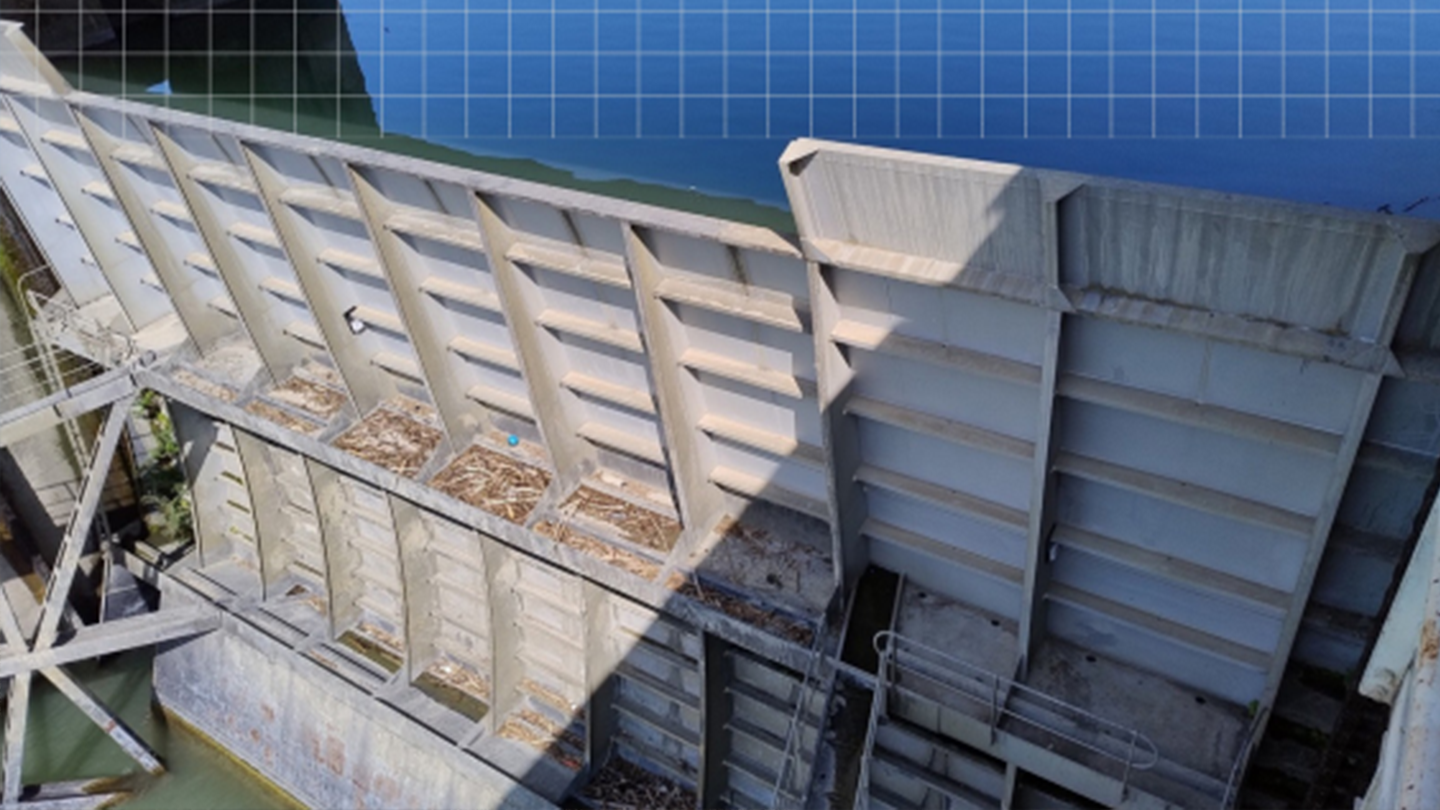
Structure monitored: Steel radial gate
Application: Structural Health Monitoring (SHM) & Experimental Modal Analysis (EMA)
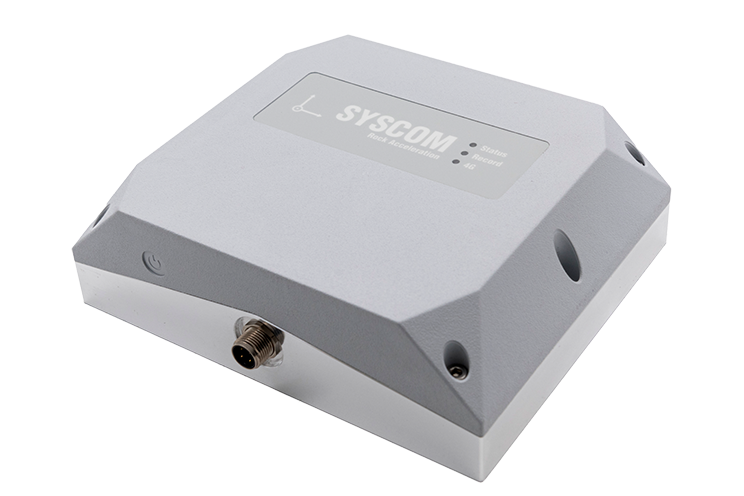
Technology: Syscom autonomous ROCK Acceleration, with auto-orienting, auto-levelling, perfectly timed synchronized features
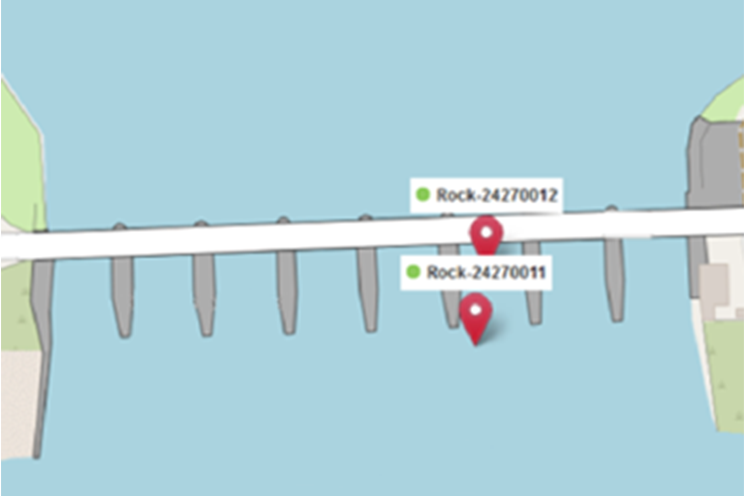
Measurement points: 2 GNSS time synchronized ROCK Acceleration with internal sensor
Objective: Modal frequency tracking, damping assessment and synchronization validation
Monitoring time: 6 months
Engineering company: Avnir Energy
Overview
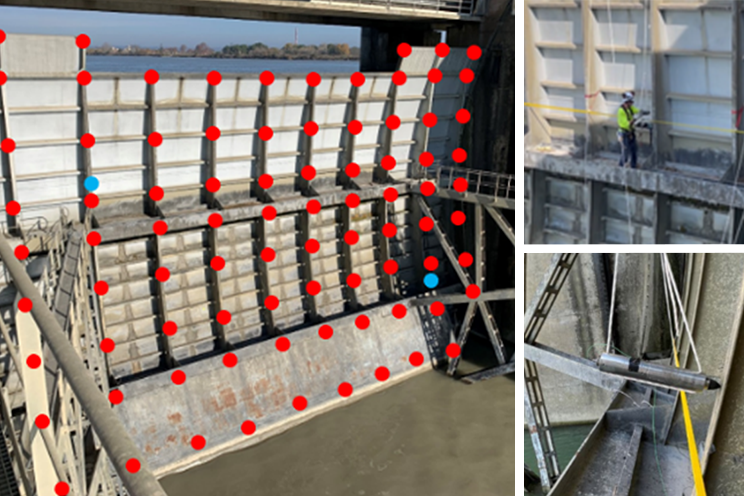
In the context of validating dynamic numerical models using finite element analysis, particularly for assessing the seismic robustness of mechanical structures, it is crucial to compare and, if necessary, adjust models based on experimental modal data.
A. Principle of Experimental Modal Analysis (EMA)
The methodology involves measuring the accelerometric response at multiple points across a structured mesh of the test object while applying mechanical excitation. When possible, the excitation force is measured using a dedicated force sensor. By analyzing the Frequency Response Functions (FRF)—which establish the relationship between acceleration at each measurement point and the applied excitation force—modal parameters can be extracted. These include:
- Mode shapes
- Natural frequencies
- Modal mass
- Damping factors (associated with structural resonance)
For large-scale structures, the use of wireless autonomous accelerometers is a significant advantage, drastically reducing installation and test durations compared to traditional wired systems. Furthermore, precise synchronization of sensors is essential to ensure accurate data processing within the target frequency range. ROCK Acceleration sensors are ideally suited for this application, operating effectively in the 0 to 200 Hz frequency range and with a synchronization accuracy of 10 µs. Their use considerably improves efficiency compared to wired accelerometers connected to a multi-channel acquisition system.
B. Operational Modal Analysis (OMA)
Operational Modal Analysis is performed by analyzing synchronously recorded response measurements, without controlling or measuring the level of excitation. If the excitation in the analysis frequency range is sufficiently strong, modal parameters can be identified, except for the modal mass, since the excitation force is not quantified. For large-scale structures, natural sources of excitation may include:
- Background seismic noise
- Wind forces
- Indirect artificial excitations such as object impacts, vehicle passage over obstacles, pendulum effects, motion from mobile masses (hydraulic actuators, electrodynamic shakers, unbalanced motors, etc.
Long-Term Modal Tracking
Once modal analysis is complete, long-term monitoring of modal parameter evolution can be highly beneficial.
For example, in the case of a dam gate, it is possible to track the influence of water levels and atmospheric conditions over time. In such cases, only a few strategically placed measurement points are required, as the modal shapes have already been identified. These points are selected based on locations where the studied modes exhibit measurable participation.
Advantages of ROCK Acceleration for Structural Health Monitoring (SHM)
For long-term SHM applications, ROCK Acceleration sensors offer a powerful solution:
- Fully autonomous operation for several weeks to months (unlimited with small solar panels), eliminating the need for human intervention.
- Continuous tracking of modal parameters with dedicated software and ROCK Acceleration input, ensuring early detection of structural changes.
- Automatic recording of transient events (e.g. impact forces, seismic activity) with streamlined data workflows.
- Real-time alerts via email or SMS for critical structural changes to different stakeholders.
By integrating ROCK Acceleration technology, structures can be continuously monitored, aiming at enhancing predictive maintenance strategies and ensuring structural safety in critical infrastructure.
Objectives
The monitoring of large hydraulic structures, such as radial gates, is essential to assess their dynamic behavior, structural integrity, and long-term stability. This case study focuses on a specific steel radial gate, where a long-term monitoring system was deployed using Syscom ROCK Acceleration sensors.
The main objectives of this project were to:
- Compare and tune the existing FEM – Finite Element Model with an initial gate response assessment with high-energy hammer excitation for future simulations
- Track modal frequency variations and damping evolution over time of the gate.
- Determine the influence of downstream water levels on structural vibrations.
- Validate the synchronization accuracy between two ROCK Acceleration sensors through simplified modal shape animation.
By utilizing advanced vibration measurement techniques and real-time data processing, this study ensures early detection of structural changes, aiding in predictive maintenance and risk mitigation at dam site and downstream.
Instrumentation Setup
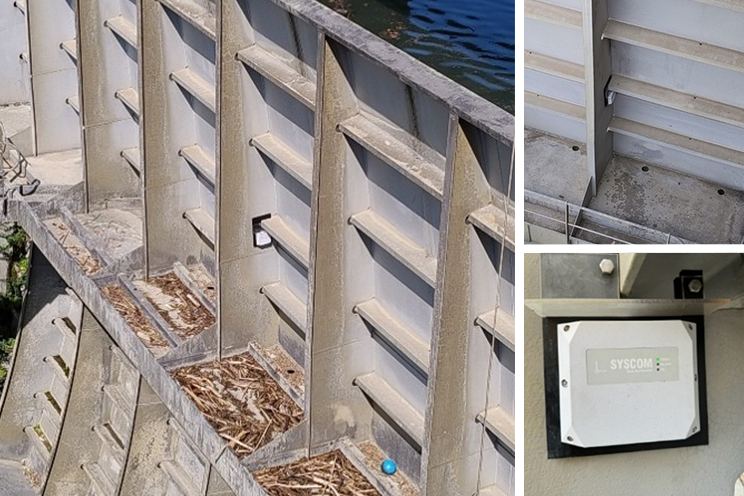
The monitoring system consisted of two ROCK Acceleration units, configured for long-term vibration analysis, using a GNSS perfectly time synchronized timed recording mode.
Equipment Used
Phase 0 (2 days), Experimental Modal Analysis (EMA):
- Generation and tuning of a FEM model, using a structured mesh with multi-points excitation with a high energy hammer.
Phase 1 (first 3 months), Operational Modal Analysis (OMA):
- 1 x ROCK Acceleration HD with MS2010 sensor (high sensitivity for detailed vibration analysis).
- 1x ROCK Acceleration with MS2012 (standard sensor for general monitoring).
Phase 2 (following 3 months), Operational Modal Analysis (OMA):
- 2 x ROCK Acceleration with MS2012 sensors.
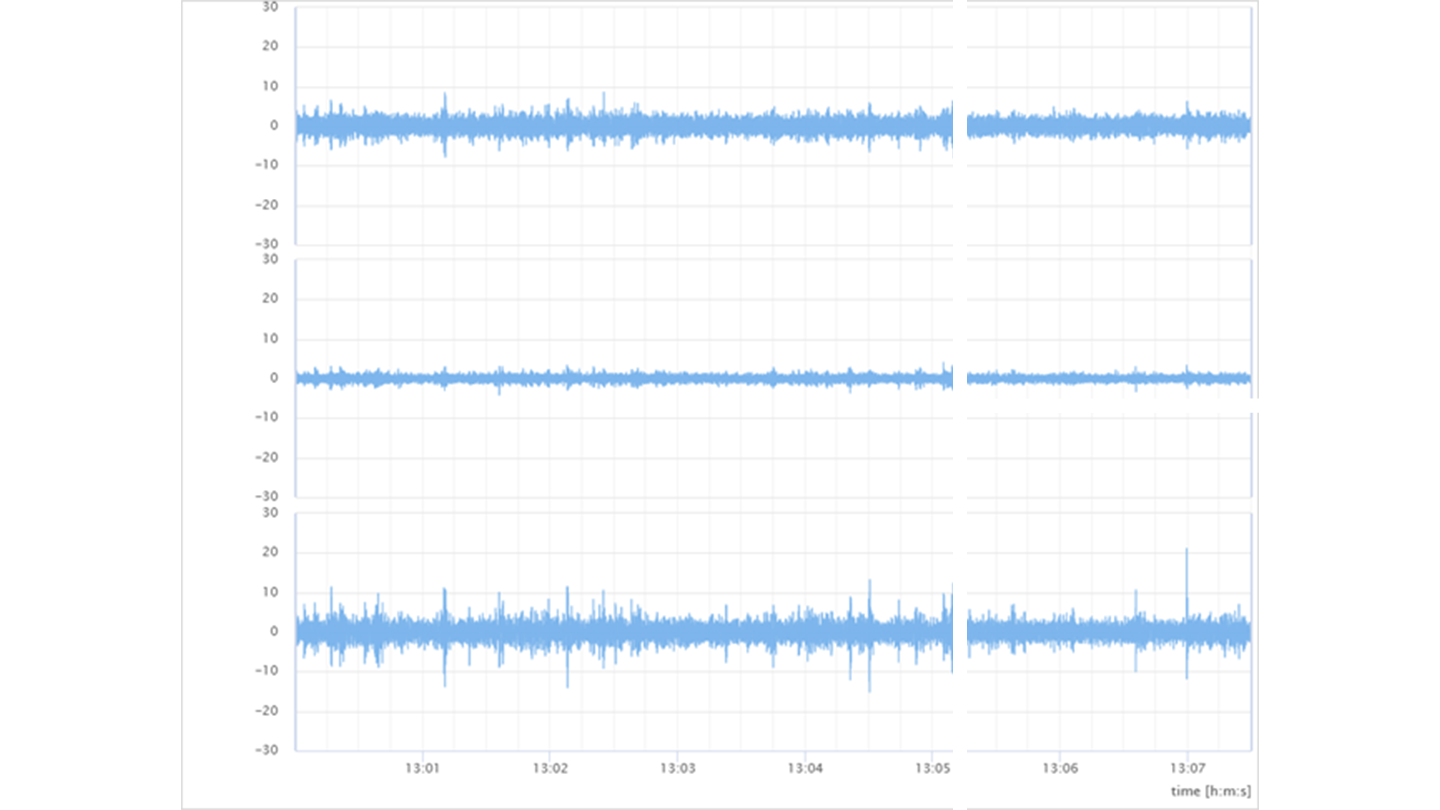
Sampling frequency: 250 Hz
Measurement duration: 7 minutes 30 seconds per session (450 seconds)
Measurement interval: Every 12 hours (15 minutes daily), timed interval recordings
Timed recording schedule: 02h00 & 14h00.
Analysis Methods
To ensure accurate modal identification and frequency tracking, two advanced analysis methods were used, calculations were done with dedicated modal analysis software:
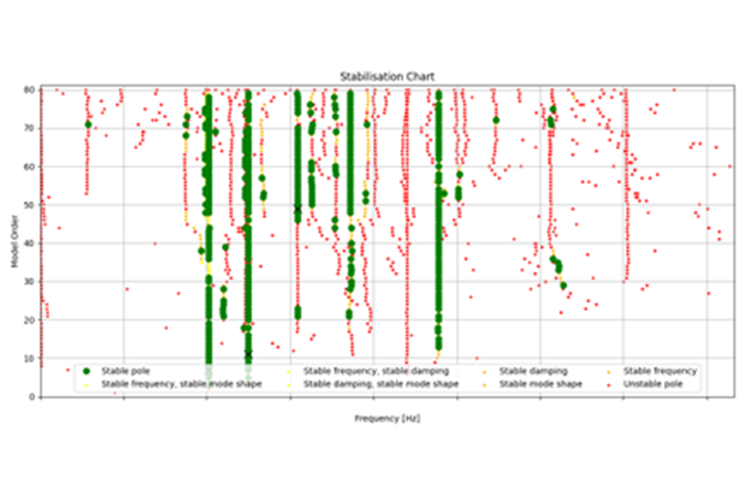
SSI-Cov (Stochastic Subspace Identification - Covariance method) used to:
- Extract modal parameters from ambient vibration data
- Help track structural changes over time with high precision.
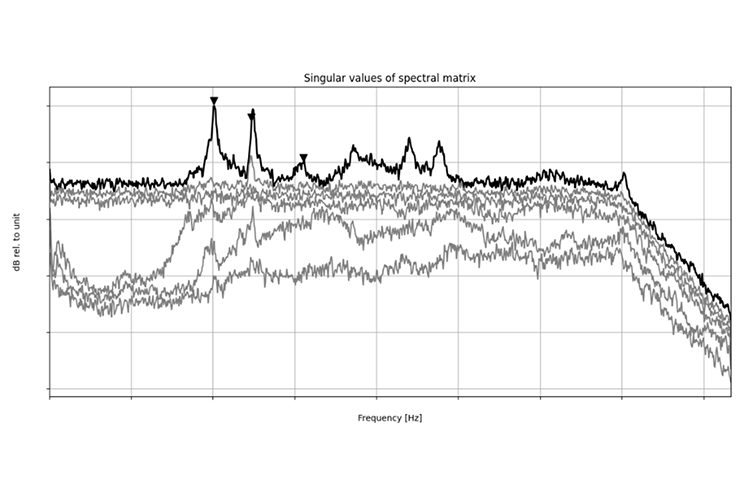
FSDD (Frequency Spatial Domain Decomposition) used to:
- Analyze specific modes of vibration
- Provide a frequency-based graphical representation of modal evolution.
Results and Observations
The data collected over six months provided valuable insights into the dynamic behavior of the dam gate.
- Modal frequency evolution tracking demonstrated variations linked to changes in water levels. Damping ratio evolution was monitored, showing dependency on excitation levels (background noise, microseismic excitation, and environmental factors).
- Sensor synchronization validation was successfully conducted by animating a simplified modal deformation.
- Graphical representation of mode evolution confirmed consistency between the two analysis methods (SSI-Cov and FSDD).
These results are essential for predictive maintenance and structural safe ty assessments, ensuring that potential fatigue, degradation, or abnormal vibration behaviors are detected early.
Conclusion
The deployment of the Syscom ROCK Acceleration system on the gate demonstrated the efficiency of long-term structural health monitoring in hydraulic infrastructure. Fully autonomous and remote monitoring enabled real-time frequency tracking without on-site intervention. Two synchronized sensors provided highly accurate modal shape validation and deformation tracking during the monitoring period. Cloud-based processing via the Syscom Cloud Software facilitated seamless data visualization and notifications processing.
This case study highlights how advanced SHM solutions can significantly enhance dam/radial gates and structures safety by providing continuous structural insights and optimizing maintenance strategies.
For more information on Syscom Structural Health Monitoring solutions, explore the Syscom SHM dynamic vibration solution and discover how it can be applied to your infrastructure projects today.
Special thanks to Avnir Energy Syscom’s partner in France, for sharing the photos and content related to this case study.
- END -