
Case Study
Model development for innovative equipment using IES and ModelNet™
03 Apr 2026
Customer profile
Nimble Resources is revolutionising mineral extraction and ore concentration with eco-friendly, efficient mobile technology. Currently a prototype, the company collaborated with Orica Digital Solutions to develop models and conduct the extensive testing required to bring its innovative technology to market.
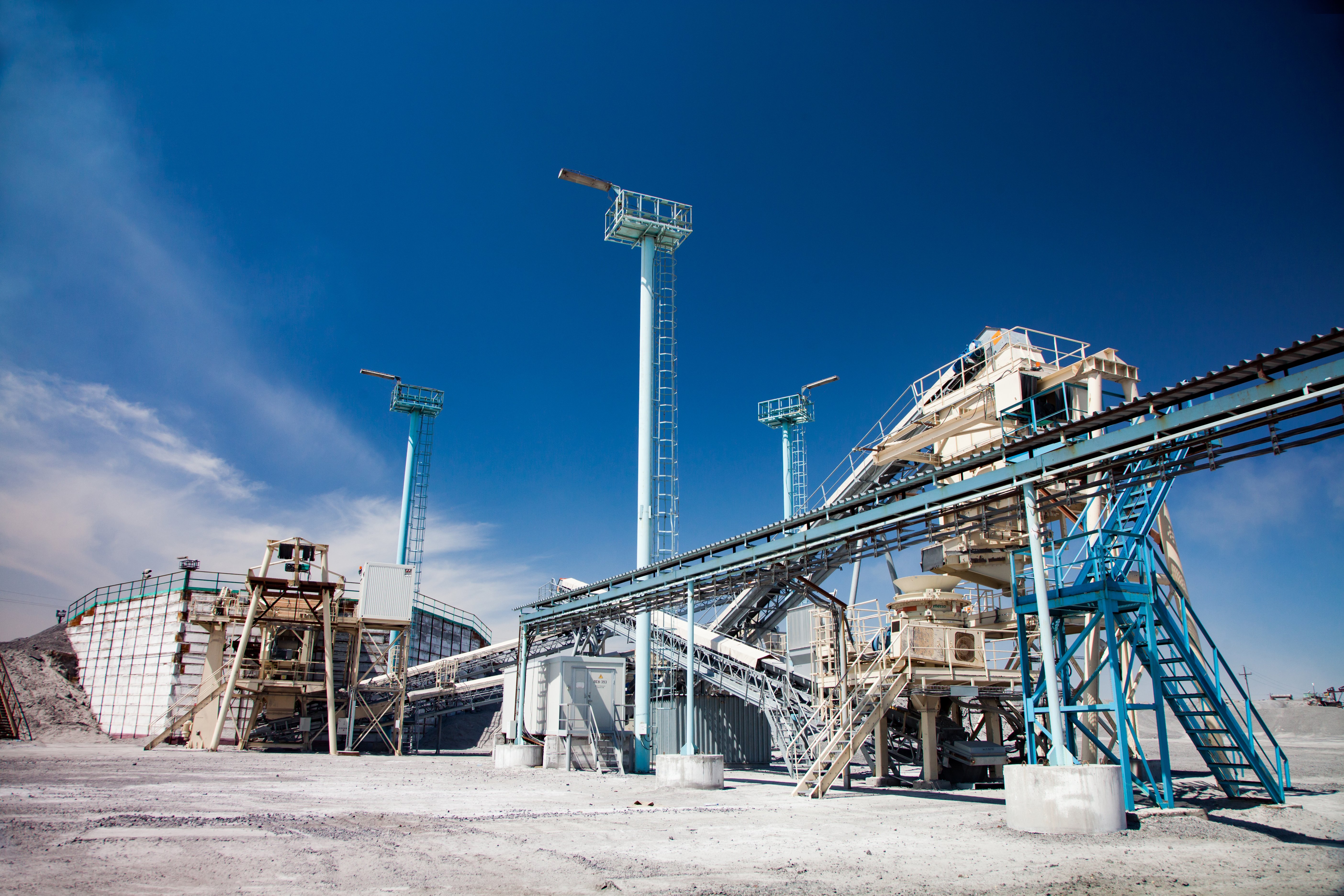
Nimble Resources own the largest mobile dry production plant in Australia. Their cutting-edge Rotary Air Concentration (RAC) technology is a completely air-based dry method for concentrating ores and minerals, making mining feasible even for the smallest and most remote ore deposits where water is limited. The RAC has the capacity to process 90 cubic meters of ore per hour. The 60-tonne RAC plant has mined deep lead paleo channels and active alluvial creek systems, both of which feature in our portfolio of gold bearing tenure.
In the landscape of new technological innovations, developing a robust model that accurately reflects the performance of the new equipment is a critical step This model evaluates the feasibility of on-site implementation and the technology’s integration within the broader processing circuit.
Nimble Resources sought to progress their device to the next stage of technology readiness, conducting pilot tests with ore sourced from a deposit with significant potential for exploitation.
The situation
Recognising the intricate nature of this challenge, Nimble Resources sought expert support in crafting a comprehensive mathematical model. This model would serve as a predictive tool and would facilitate a thorough assessment for the implementation of the RAC.
In collaboration with Orica Digital Solutions, Nimble Resources aimed to enhance their understanding of the technology's performance under varying conditions, ensuring successful integration into an operational process.
The scope of the work performed by Orica Digital Solutions involved three major objectives:
- Collaborate with Nimble Resources to design a test program that facilitates the development of an effective model.
- Use the pilot test data to build a Machine Learning (ML) model in ModelNet™ and deploy it in the Integrated Extraction Simulator (IES) environment.
- Use the model, along with the geological block model data of the potential deposit, to provide a comparative assessment of using the RAC against a baseline circuit without it.
Technical solution
The project was executed in three key phases:
Phase A: Trial methodology
A major requirement was to collate a dataset that included the key attributes with sufficient data density to build and validate a model. Orica Digital Solutions provided advice on the nature of the test work, laboratory analysis and raw data to be collected.
Phase B: Trial management, mass balancing and ML model development in ModelNet™
IES and ModelNet™ applications were used to take the data from the test-work program through a multistage
process to build a neural network model of the RAC.
Phase C: Opportunity assessment
Evaluate the use of the RAC in a circuit to extract additional value out of mining operations for the potential deposit.
The implementation of the ML model in ModelNet™ deployed in IES allowed Nimble Resources to simulate multiple scenarios prior to the implementation of the RAC technology and predicted the expected recovery of ore initially defined as waste.
The result
Method and mass balance
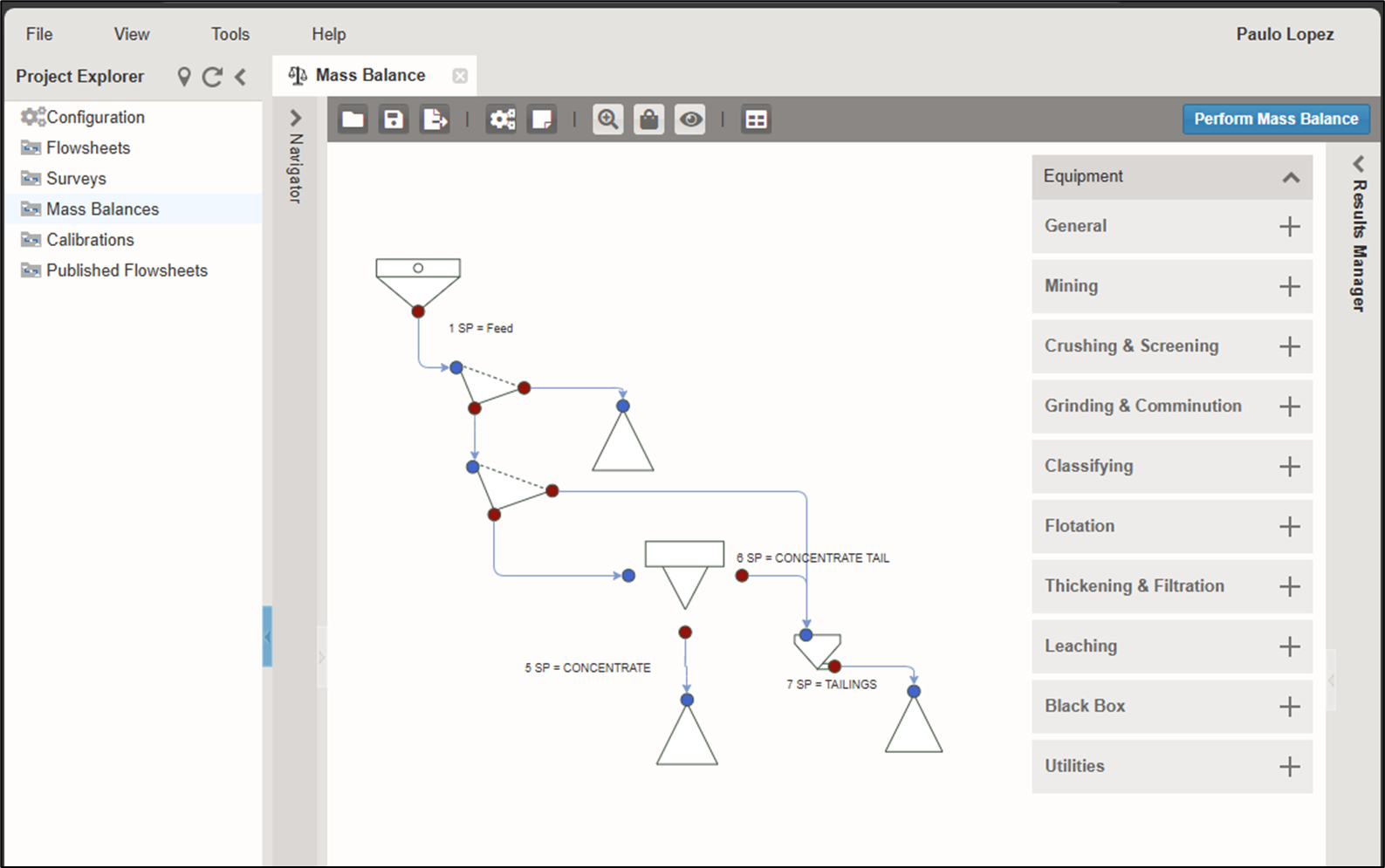
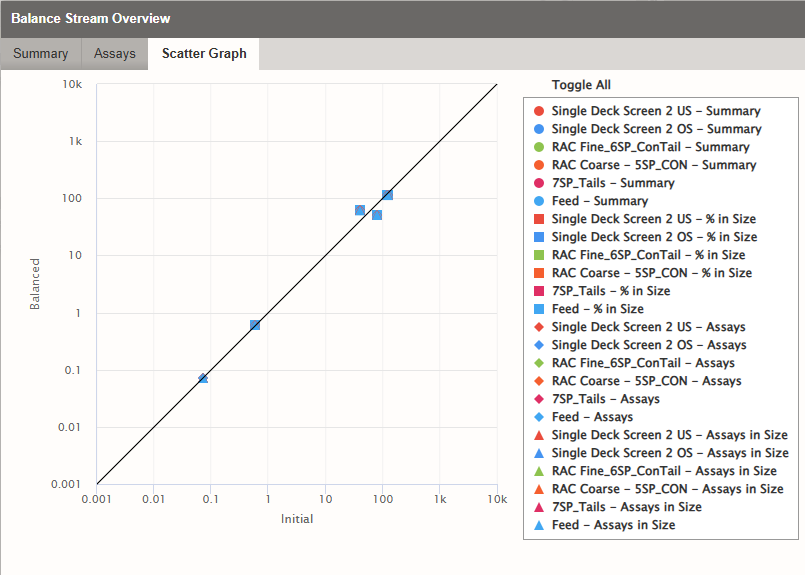
Laboratory assays were incorporated in the Survey feature in IES, and later the Mass Balance capability was used for each trial performed onsite. The mass balance function in IES includes the assignment of “confidence”; a qualitative measure to the values for solids flow and assays which are then considered for the mass balance calculation. The following images show the results for one of the samples. It can be noted the consistency for “Initial” and “Balanced” values indicating good measurements had been taken. Overall, there was good agreement between those values for all the samples as seen in Figure 2.
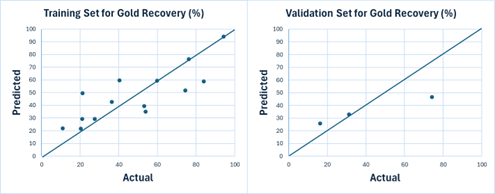
Machine learning model developed in ModelNet™
The model was developed using a set of input and output features; input features included rotor and fan speed, feed rate and feed grade and, the output features were recovery and mass pull.
Opportunity Assessment
To assess the potential for the RAC to extract more value out of the mining project, two scenarios were evaluated considering the potential deposit.
- Use the equipment to process ore initially defined as waste.
- Use the equipment to pre-concentrate all feed ore.
Scenario 1 used the mine pit final design for the potential orebody. It identified the destination of blocks which were defined as leach, concentrator or waste, and therefore it was possible to quantify potential revenue generated by recovering the valuable metal in the waste stockpile. There were roughly 9,000 oz of unrecovered waste ore and simulations indicated incorporating the RAC could lead to a possible recovery of around 5,000 oz (nearly 53% of recovery).
Scenario 2 considered a concentration state (milling and flotation) able to recover 0.4 Moz of gold (recovery 79%). With the RAC the recovery drops to 0.36 Moz, but the capital cost of gold separation units reduces significantly due to the amount of ore processed (1/100 ). This is due to almost half of the gold contained in blocks where the RAC recovery is higher than 87%.
The implementation of the ML model in ModelNet™ deployed in IES allowed Nimble Resources to simulate multiple scenarios prior to the implementation of the RAC technology and predicted the expected recovery of ore initially defined as waste.
Acknowledgements
Orica Digital Solutions wishes to thank Nimble Resources for their support and permission to publish this case study.
Related products and services

Business
Digital Solutions
Digital Solutions
Blast Design and Execution
