
Case Study
16% reduction in drill and blast costs at Candelaria Mine with 4D™ and DfO technology
17 June 2026
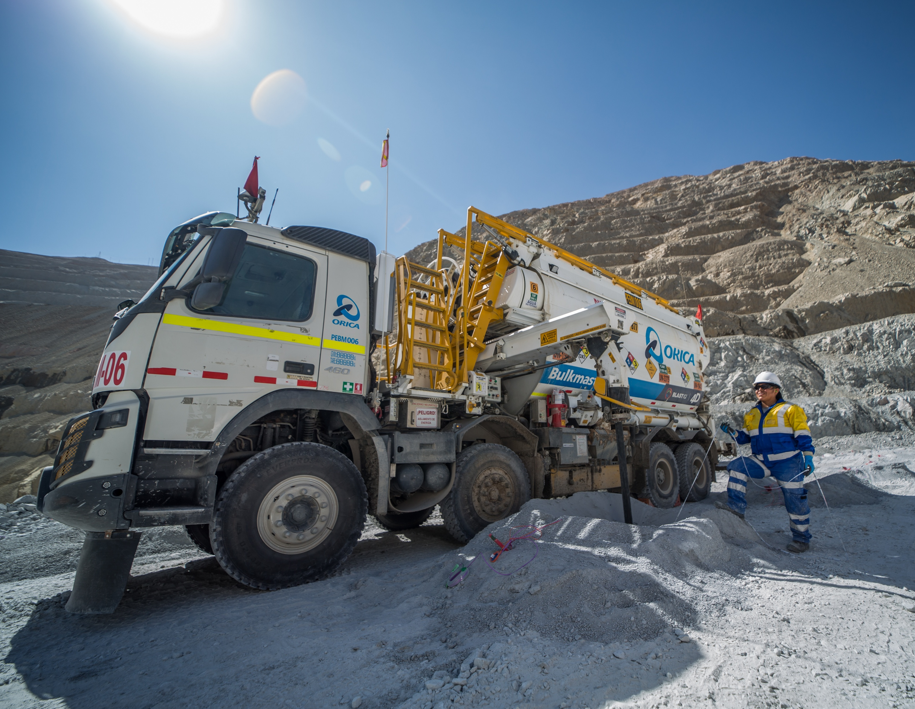
Compañía Contractual Minera Candelaria, Atacama, Chile. Lundin Mining.
Compañía Contractual Minera Candelaria (CCMC), operated by Lundin Mining, is an iron-copper-gold oxide deposit located nine kilometres south of Tierra Amarilla, in the Atacama Region of Chile. The operation uses both open-pit and underground mining methods.
The deposit was discovered in 1987 and mining began in 1995. Ore is processed through a concentrator and flotation plant to produce copper concentrate with a grade of 30%. The copper concentrate is transported by truck to the port of Punta Padrones, in the commune of Caldera. The concentrator plant has an ore treatment capacity of 75,000 tonnes per day.
As Minera Candelaria develops the deeper phases of the pit, maintaining competitive costs while achieving optimal blasting results is a key priority.
Orica is Candelaria’s long-term explosives supplier, delivering explosives through a Total Load Service with an on-site team of more than 40 people.

The situation
In 2024, CCMC and Orica began a comprehensive drill and blast optimisation project. The objectives were to reduce drilling and blasting operating costs and increase excavation rates while improving or maintaining key fragmentation measures in ore. If successful, the project would support improved productivity across the mining operation.
At the beginning of the project, Minera Candelaria used special explosive formulations to achieve high and low Relative Bulk Strength (RBS) blends. These included Orica’s low-RBS Flexigel™ Extra, the mid-range Fortis™ Extra, and the high-RBS Vistis™.
While these legacy blends delivered a wide range of energy, they required specialised raw materials and capital-intensive material handling systems and delivery equipment.
Orica and Minera Candelaria sought a way to deliver the optimisation program targets by adopting the latest technology in blast design and bulk explosive delivery.
Technical solutions
4D™ bulk system
Orica’s 4D™ bulk system expands the range of energy that can be supplied from a single Mobile Manufacturing Unit (MMU)™ without large volumes of special raw materials such as aluminium and polystyrene.
4D™ uses a modified MMU™ with Orica’s LOADPlus™ control system to produce each bulk explosive column to a specified Relative Bulk Strength. Energy can be varied on a hole-by-hole basis during loading, helping designers match explosive energy to the required blasting outcome.
Design for Outcome
Orica’s Design for Outcome (DfO) is a data-driven blast design approach. DfO applies machine learning to measure-while-drilling (MWD) data to classify rock into blasting domains and match explosive energy distribution to blasting outcomes.
As part of the optimisation program, Orica and CCMC agreed to carry out four evaluation blasts to demonstrate the potential of 4D™ and DfO to achieve the program objectives.
The limitations of conventional bulk systems and design methods
In conventional gassed bulk explosives, density and energy increase with depth due to hydrostatic pressure. This concentrates energy towards the bottom of the column. Hydrostatic pressure also decreases sensitivity with depth, limiting the average density and energy of the column in deeper holes.
In manually controlled delivery systems, the density, sensitivity and energy limitation of the deepest hole in the pattern is applied to all holes in the pattern to avoid misfires and poor explosive performance.
Conventional blast design methods use the average drill penetration rate as a proxy for rock hardness across large groups of holes. This process has significant limitations. Penetration rate alone does not adequately define the blasting response of the rock, and productivity and payload constraints of conventional delivery systems restrict the frequency of product changes delivered across the pattern.

Figure 2. The energy distribution of conventional gassed emulsion is limited by hydrostatic pressure
The 4D™ bulk system and DfO
4D™ extends the range of Relative Bulk Strength compared to conventional bulk systems and enables more precise energy delivery to each hole. It provides low-RBS options for wet holes that cannot be loaded with ANFO and high-energy options for hard ground without compromising sensitivity.
4D™ modifies density within the column to provide more even energy distribution. This gives designers the option to expand patterns and reduce powder factor without compromising fragmentation. In variable terrain, designers can specify a different average RBS for each blast hole if required.
DfO algorithmically classifies the rock using MWD data and automatically produces outputs that drill and blast engineers can use for design. DfO and the 4D™ delivery system are integrated through the BlastIQ™ digital platform. This workflow efficiently produces hole-by-hole, energy-matched loading instructions that can be delivered digitally to the bench.

Figure 3. The 4D™ Bulk System modifies density to achieve a specified average Relative Bulk Strength (RBS) for each hole

The result
Candelaria and Orica jointly applied 4D™ and DfO in more than 200 blasts in ore and waste from March 2025. Over a 10-month period, drill and blast costs were reduced by 16% compared to a January 2024 benchmark, without affecting fragmentation and mining performance.
Of the total cost savings, 58% were attributed to expanded blast patterns and 42% were attributed to blast design process improvements under DfO.
The cost savings were mainly attributable to:
- Reducing the volume of special raw materials used to manufacture legacy high and low energy bulk explosives.
- Reducing the volume of explosive used, with powder factor reduced by around 20% without affecting fragmentation.
- Increasing the size of blasts by around 15%.
- Improving productivity of the MMU™ fleet by reducing the volume of specialty legacy high and low energy bulk products.
Combining 4D™ and DfO integrates rock mass knowledge with the precise and efficient application of explosive energy. This provides a seamless workflow from drilling to energy delivery, enabling better fragmentation and excavation rates.

Figure 5. At Candelaria, 4D™ and DfO reduced costs without compromising excavation productivity
Orica's 4D™ bulk system gives us greater flexibility in design and better blasting results when used with Design for Outcome. We welcome the results of the demonstration and look forward to adopting the technology.
— Luis Vera Monsalve, Drill & Blasting Sub-manager, Lundin, Candelaria, Copiapó
Acknowledgements
Orica is grateful for the collaboration with CCM Candelaria, allowing us to jointly find improvements for their operation through our technologies, while complying with safety standards, maintaining positive interaction with communities and preserving the environment.
Authors: Pablo Rojo, Blasting Engineer; Sebastián Balboa and Pablo Fredes, Technical Services Engineers; Claudio Morel Role, Lead - Technical Services Engineer; Diego Navarrete, Site Lead.
Disclaimer
© 2026 Orica Group. All rights reserved. All information contained herein is provided for informational purposes only and is subject to change by the Orica Group without notice. Because the Orica Group cannot anticipate or control the conditions under which this information and its products and/or services may be used, each user must independently review and evaluate the information in the specific context of the intended application. To the fullest extent permitted by law, the Orica Group specifically disclaims all warranties express or implied by law, including accuracy, non-infringement, and implied warranties of merchantability or fitness for a particular purpose. The Orica Group specifically disclaims, and shall not be liable for, any liability or damage resulting from the use of or reliance on the information contained herein. The word Orica and the Ring device are registered trademarks of the Orica Group.
Related products and services

Blasting Solutions
4D™ Surface

Digital Solutions
BlastIQ™
