
Case Study
Unlocking uphole stope recovery with WebGen™
17 June 2026
Éléonore Mine, James Bay region, Québec, Canada.
Éléonore is an underground gold mine in the James Bay region of Québec, Canada, approximately 350 kilometres north of Matagami. Commercial production began in 2015.
As mining progresses to greater depths, methods must continually adapt to safely manage increased induced stress in the orebody and rising mining costs. To address these constraints and support a safe and efficient extraction strategy, Éléonore uses a top-down mining sequence.
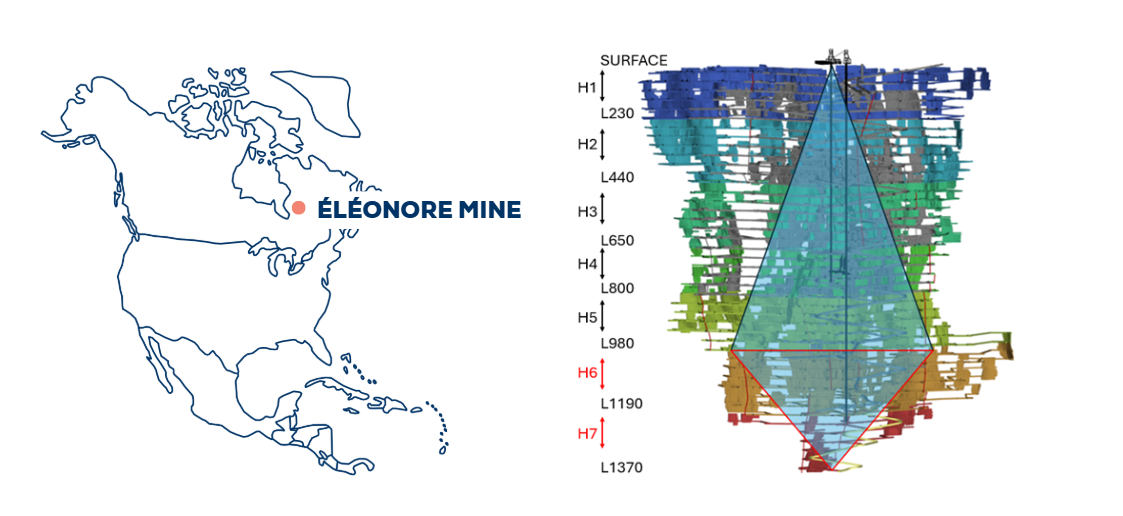
This sequence, implemented from horizon 6 (H6) and below, incorporates uphole open stoping.
Éléonore first engaged Orica’s WebGen™ wireless blasting service in 2019. As one of the earliest adopters of the technology, Éléonore has pioneered new methods of wireless pre-charging in production mining.
The situation
Uphole stoping introduced new challenges at Éléonore. The most significant was inconsistent raise opening height, which led to poor recovery.
In underground blasting, the success of the first opening has a direct impact on overall stope performance. Any deficiencies in the raise can negatively affect the remainder of the stope.
The conventional uphole design, based on wired electronic initiation, provided limited or no options to safely recover unliberated ore if the raise was not successful.
In response, Éléonore sought Orica’s expertise to safely improve uphole stope recovery using Orica’s WebGen™ wireless initiation system.
Technical solutions
WebGen™ wireless initiating system
Orica’s WebGen™ wireless initiating system uses low-frequency magneto-inductive signals that travel through rock, air and water to initiate primers in blastholes. The system supports improvements in personnel safety, recovery, mine productivity and blasting flexibility.
As a solution, the uphole stope standard was redesigned to integrate WebGen™. The new design incorporated dumped sections drilled towards the raise, combined with pre-charged rings initiated with WebGen™ firing into the raise, which was initiated with i-kon™ electronic detonators.
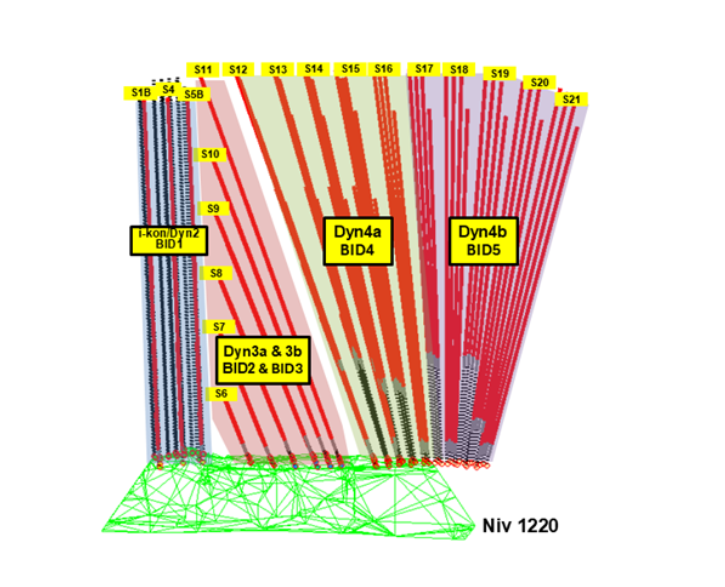
Safer recovery through preloaded wireless sections
The preloaded wireless sections provide a safe recovery option in the event of poor raise performance. These rings are initiated remotely, without the need for a person to enter the active mining area to charge or connect blastholes.
The implementation of WebGen™ offered several key benefits:
- Eliminating personnel exposure to the active stope between blasts.
- Providing options to mitigate ore loss if the raise fails.
- Reducing stope turnover time through faster single pass loading and pre-charging methods.
- Providing flexibility to change the blasting sequence and combine blasts based on cavity scan results as the stope progresses.
As part of the WebGen™ enhanced blasting service, Orica’s WebGen™ specialists managed the design, execution and quality control throughout the project.
The result
The strategic integration of WebGen™ wireless initiation technology played a decisive role in improving uphole stope blasting performance at Éléonore.
The preloaded dumped sections successfully fulfilled their contingency purpose after suboptimal raise performance in uphole stope 1220-6020-359.
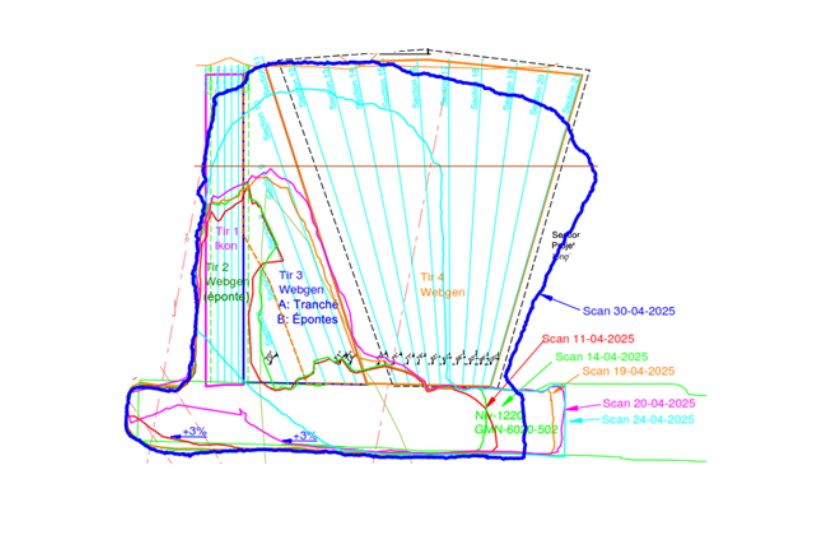
Measured stope performance
The measured performance showed that overall dilution was 60% less than designed. Blasting less dilution resulted in a higher recovered ore grade.
The WebGen™ preloaded dumped sections enabled a 231% increase in initial recovery. The combined loading approach effectively mitigated the unsatisfactory initial recovery performance, allowing the stope to meet the designed recovery target while reducing the planned dilution ratio.
Single pass pre-charging of the fully drilled stope was much faster than conventional methods. The WebGen™ portion of the stope took only three days of charging to yield 15,036 tonnes at 4.47 grams per tonne of ore.
- | Designed1 | Raise | WebGen™ | Total |
| Tonnage (in-situ) (t) | 14,277 | 790 | 13,487 | 14,277 |
| Grade (in-situ) (g/t) | 4.88 | 4.88 | 4.88 | 4.88 |
| Dilution (%) | 35% | 16% | 14% | 14% |
| Recovery (%) | 88% | 39% | 91% | 88% |
| Tonnage2 | 17,561 | 440 | 14,203 | 14,643 |
| Grade3 | 4.01 | 4.00 | 4.47 | 4.46 |
1. In-situ tonnage and grade of 14,277 t @ 4.88 g/t.
2. Tonnage calculated using dilution and recovery assumptions.
3. Considering dilution grade @ 1.84 g/t.
WebGen™ helped improve safety by eliminating operator exposure once the stope entered production. It also increased productivity by enabling innovative blast designs and supporting continuous operation with reduced interruptions, delivering a 231% increase in initial recovery and around 60% less dilution than planned.
— Danny Provost, Drill and Blast Engineer, Dhilmar - Éléonore
Acknowledgements
Orica is grateful for the collaboration with Dhilmar, especially Dany Provost, Valérie Polchtchikov and Robert Douangni, for giving us the opportunity to jointly find improvements for the Éléonore operation through our technologies, while complying with safety standards, maintaining positive interaction with communities and preserving the environment.
Orica would also like to thank Michaël Raymond, Olivier Higaniro, Massiga Keita and Patrick Gagnon.
Author: Michaël Raymond, WebGen™ Technical Specialist, Orica.
Related products and services

Solution
Stope Optimisation

Blasting Solutions
WebGen™

Blasting Solutions
i-kon™
