
Insight
Automated Geotechnical Monitoring for Effective Observational Method in Urban Excavations
24 Apr 2026
Authors
A. Silva1, C. Levesque, C. Martins, R. Tomásio; Measurand (São Paulo, Brazil & Fredericton, Canada) and JET SJ (Lisboa, Portugal)
Abstract
Urban excavations in densely built environments demand continuous awareness of wall stability and the surrounding infrastructure. This white paper distils an ECSMGE 2024 case study of the "Phoenix Building" excavation in Lisbon, Portugal, where an automated instrumentation plan, including ShapeArray automated inclinometers, biaxial tiltmeters, vibrating-wire piezometers, and MEMS load cells, was used to implement the Observational Method. Automated (6-hour) readings were streamed to a cloud platform, enabling near-real-time interpretation, timely alerts, and corrective actions when anchor wedges malfunctioned. Comparing finite element model predictions with field observations revealed sections with elevated displacement (I3, I4), triggering alert/alarm thresholds and leading to remedial anchoring and stabilisation. The program demonstrates how automation, redundancy, and rapid visualisation reduce uncertainty, improve safety, and optimise cost during excavation and structural transition phases.
Introduction
Dense urban projects involve complex soil-structure interactions, utilities, rail corridors, and traffic loading. The Observational Method relies on planned monitoring to validate predictions and adapt construction as conditions evolve. In the Lisbon case, a 50 cm reinforced-concrete diaphragm wall retained three basement levels, while temporary anchors and struts ensured stability during excavation. After structural completion, the temporary systems were decommissioned as the building assumed its load-sharing capacity. This paper details the automated monitoring architecture, alarm criteria, and lessons learned from deviations between modelled and observed behaviour.
Materials and Methods
Technology Overview
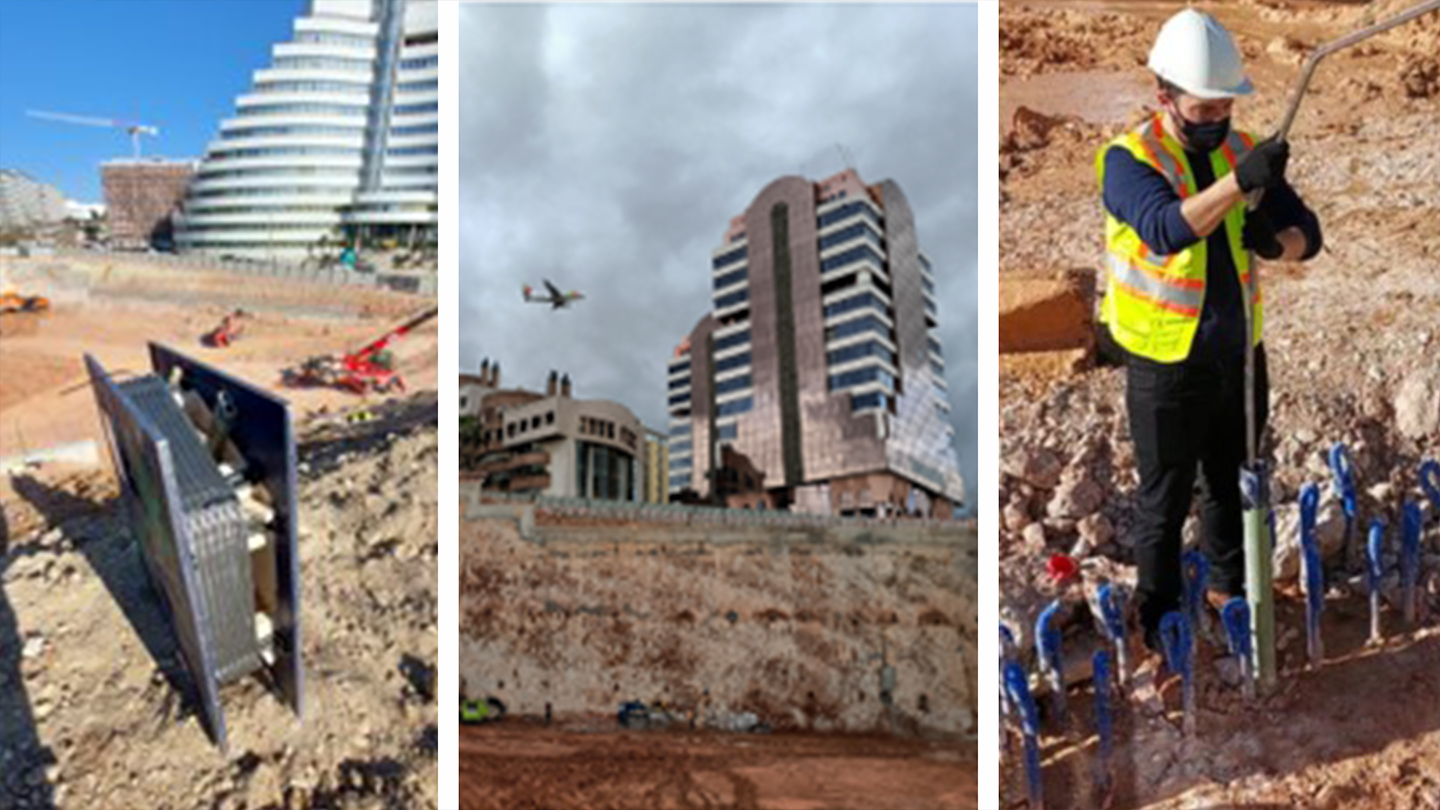
- ShapeArray automated inclinometers: Continuous profiles of horizontal wall displacement (four arrays across key cross-sections).
- Biaxial tiltmeters: Rotations on diaphragm wall panels (30 units).
- Vibrating-wire piezometers: Groundwater level tracking (4 units).
- MEMS load cells: Anchor loads at reference alignments (16 units).
- Topographic prisms: Monthly settlements of surrounding structures (9 points; non-automated).
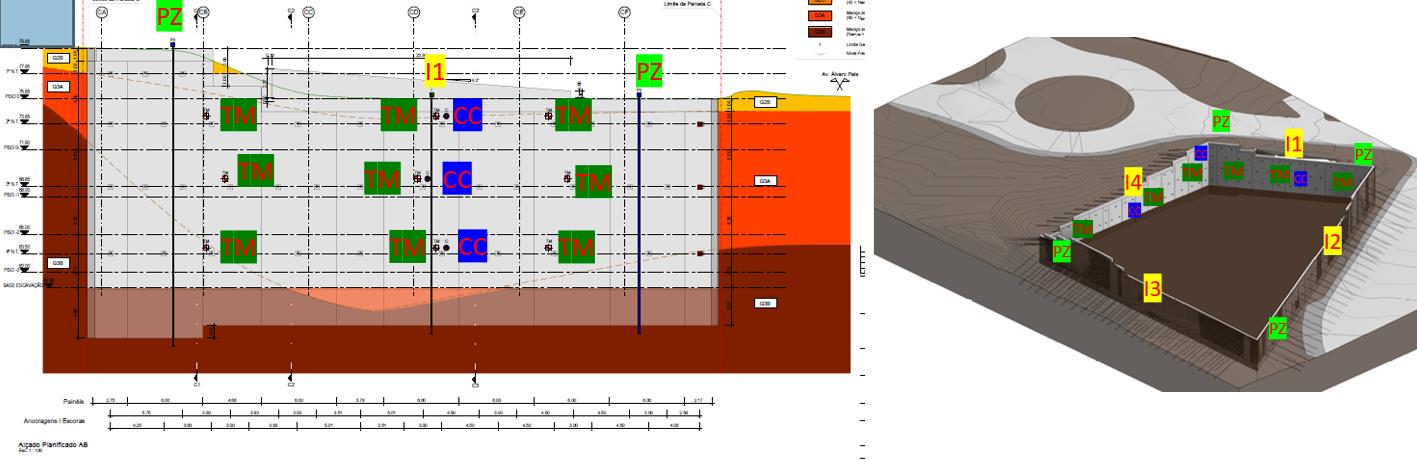
Figure 1. Instrument layout across design elevations and BIM 3D overview (placeholder).
Deployment Strategy
Devices were configured for automated acquisition at ~6-hour intervals during excavation, retaining-wall, and early superstructure phases. Dataloggers and gateways transmitted readings to the Level-GAM online platform for secure storage, visualisation, and alerting. Finite element models (FEM) defined expected displacements considering stratigraphy, hydrogeology, anchor geometry, loads, and wall parameters. Model outputs established alert (25 mm) and alarm (35 mm) criteria for horizontal displacement, with vertical thresholds of ~10–15 mm.
Case Study: Phoenix Building, Lisbon
Excavation reached maximum depth in May 2022. Subsequent monitoring revealed continued displacement increases in sections I3 and I4, with I4 reaching ~38.5 mm by January 2023, exceeding the 35 mm alarm threshold. A period of intense rainfall (November–December 2022) coincided with acceleration, and investigations identified anchor wedge malfunctions that prevented strand lock-off in several areas. Corrective measures, including complementary anchors, were implemented by late December, after which wall behaviour stabilised.
Results and Discussion
Measured vs. modelled displacements varied by location: I1 and I2 tracked predictions closely, while I3 and I4 exceeded expectations and crossed alert/alarm limits. Instrumentation redundancy (inclinometers corroborated by tiltmeters and load cells) supported diagnosis and timely remediation.
Environmental loading from rainfall and slope saturation near instrument panels further contributed to transient increases. Post-remediation trends indicated stabilisation, validating the Observational Method and the value of automated data.
An integral facet of the analysis revolves around the pace at which excavation and anchor tensioning occurred. To shed further light on this aspect, the following figure presents the maximum cumulative displacements during the excavation phase, focusing on inclinometer I4, which exhibited the largest cumulative displacement.
Additionally, Figure 2 depicts the key milestones, including the testing dates for the closest anchors (N1, N2), the conclusion of the excavation phase in May 2022, and a transitional period spanning from the completion of excavation to the initiation of the structural phase. Moreover, a specific emphasis will be placed on a notable period characterized by particularly intense rainfall between November and December 2022.
These temporal markers are crucial for a comprehensive understanding of the interplay between excavation and anchor tensioning and their influence on the diaphragm wall's behaviour, especially in the context of external environmental factors such as heavy rainfall.
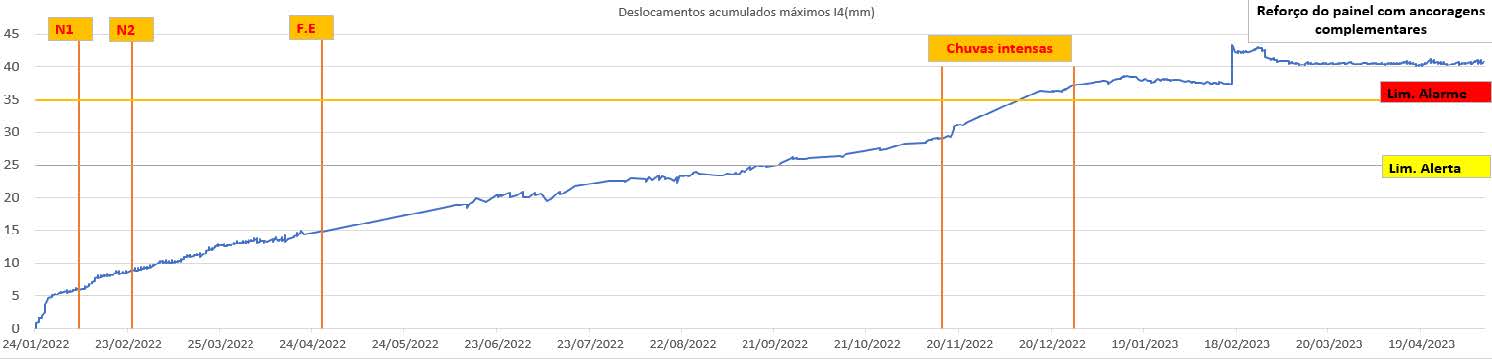
Figure 2 - Cumulative displacement plot with emphasis on the installation’s stages of the anchors (N1, N2), end of excavation (F.E), period of heavy rains (Nov/Dec 22) and last reading made available (May/23), after reinforcement of the panel with complementary anchor.
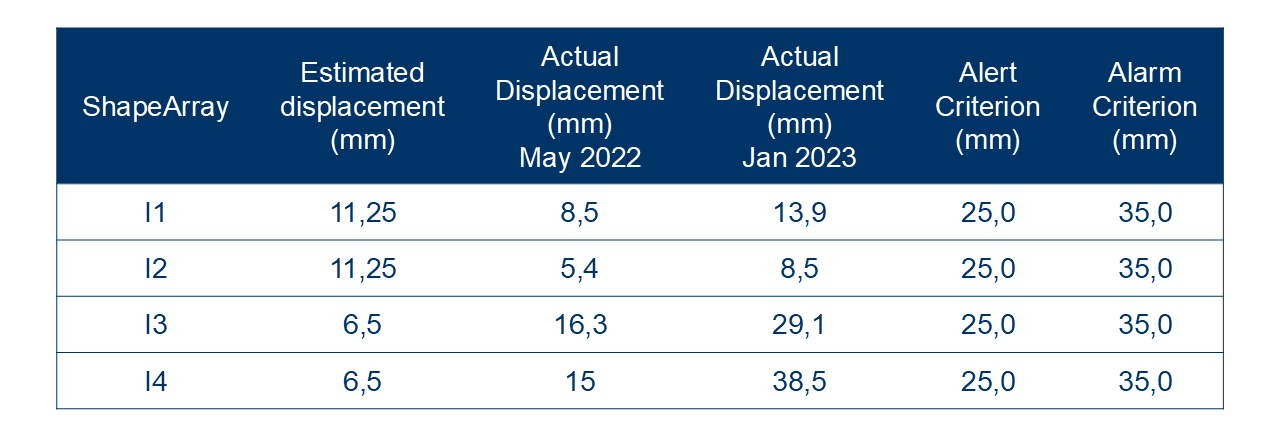
Table 1. Comparison of expected and observed horizontal displacements (selected locations).
Conclusion
Automated geotechnical monitoring, integrated with an Observational Method framework, enabled rapid detection of deviations, data-driven decisions, and effective corrective actions in a constrained urban excavation. Cloud visualisation platforms and routine, automated acquisition reduced oversight gaps and provided continuous assurance during the transition from excavation to structure. Projects with similar constraints should adopt high-frequency, redundant instrumentation and clear alert/alarm criteria linked to actionable responses.
References
Silva, A., Levesque, C., Martins, C., & Tomásio, R. (2024). Automated monitoring for effective implementation of observational method in an urban excavation in Lisbon, Portugal. In Proceedings of the XVIII ECSMGE 2024 (Lisbon, Portugal). ISSMGE Online Library.