
News
Our decarbonisation pathway and tertiary abatement
10 Apr 2025
We explore Orica's efforts in building climate resilience and promoting circularity within our business and how we are leveraging technology to provide solutions that support our customers' sustainability goals. To do this, we have taken a deep dive into our decarbonisation journey with Meredith Read, Head of Sustainability.
Transforming Challenges into Opportunities for a Sustainable Tomorrow
In the face of escalating climate challenges, the mining and infrastructure sectors are at a pivotal crossroads. Extreme weather events, such as severe droughts and storms, intense heat waves, and devastating floods, are disrupting mining operations and infrastructure stability. Simultaneously, the transition to a low-carbon economy is placing unprecedented demands on the industry to supply essential minerals while also reducing its own carbon footprint. As our industry adapts to new environmental conditions, we must innovate and implement sustainable practices and solutions to ensure long-term success.
The Orica Journey
At Orica, we are changing how we work, so that sustainability sits alongside safety at the core of all we do. We are transforming our business towards the commodities needed for a low-carbon economy and delivering smarter solutions that are helping our customers operate more safely, productively, and sustainably.
Decarbonisation Journey
Orica's approach to decarbonisation globally has focused on the most material emissions from our operational assets and what we can control in the first instance.
Meredith Read, Head of Sustainability at Orica, explains,
Our decarbonisation journey has been a key focus, starting with the areas where we can make the most significant impact. By implementing effective ESG solutions, we are committed to reducing our emissions and driving positive change
Our road map for decarbonisation and the achievement of our 2030 climate targets has really focused on the nitrous oxide emissions from our nitric acid manufacturing assets across the world.
One of the core solutions that Orica has focused on in our decarbonisation journey to date has been the implementation of tertiary catalytic abatement across a number of our nitric acid manufacturing assets globally. "We have progressively deployed tertiary catalytic abatement into a number of these assets both here in Australia and in Canada," says Read. This technology acts like a catalytic converter in a car, breaking down nitrous oxide, which exists in the exhaust gas of these plants, into nitrogen and oxygen, rendering what was a potent greenhouse gas effectively harmless to the atmosphere. To put it in perspective, this milestone is equivalent to removing approximately 600,000 cars from the road annually.
Key Focus Areas
Our decarbonisation efforts are centered around key focus areas where we can make the most significant impact.
Meredith Read elaborates,
We aim to reduce Scope 1 and 2 GHG emissions by at least 45% by 2030, prioritising industrial process emissions and nitrous oxide abatement. Additionally, we are targeting 100% renewable electricity across our operations by 2040, with an interim goal of 60% by 2030.
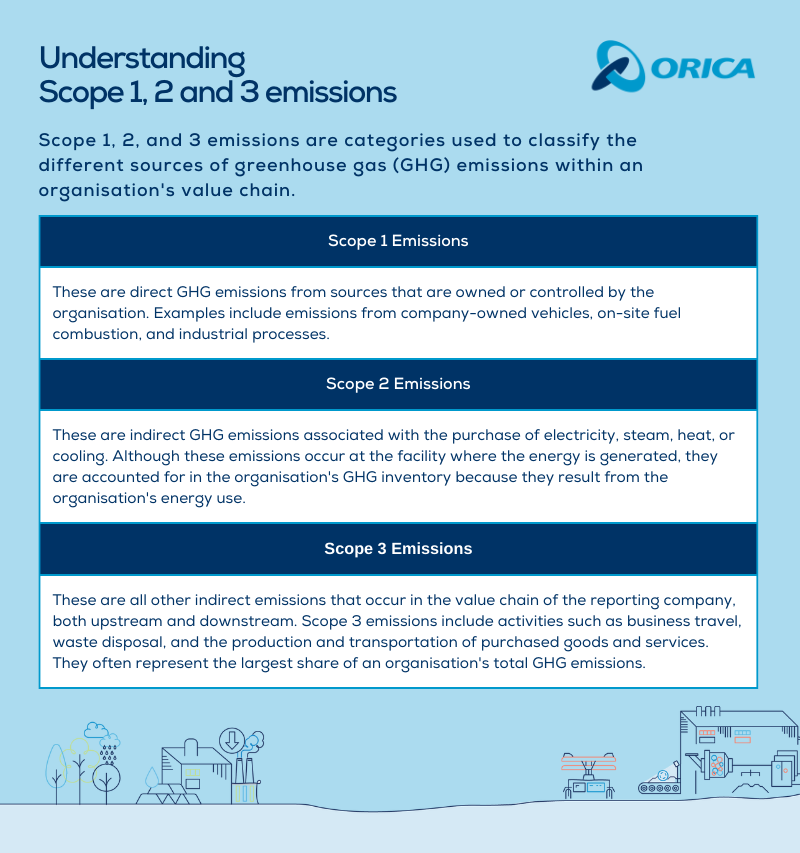
Figure 1: Scope 1, 2 and 3 emissions are categories used to classify the different sources of greenhouse gas (GHG) emissions within an organisations value chain.
To progress Orica towards our renewable electricity target, we have secured a power purchase agreement for our NSW operations and progressed the sourcing of renewable energy certificates for our Carseland facility in Canada from January 1, 2025.

Figure 2: The reduction of Scope 2 emissions is integral to Orica’s broader sustainability goals. We aim to power our business with 100% renewable electricity by 2040, with an interim goal of 60% by 2030
Orica's decarbonisation pathway is a key component of our sustainability strategy. By leveraging innovative technologies and setting ambitious targets, we are committed to reducing our emissions and driving positive change.
Discover how Orica is reducing emissions, enhancing safety, and driving positive change in the mining and infrastructure sectors.
Follow Our Path to a Sustainable Future visit: orica.com/sustainability
Andrew Valler
Andrew Valler
Media Contact
Head of Communications
Mobile +61 437 829 211
Natalie Worley
Investor Relations
Vice President
Mobile +61 409 210 462